Call on international human rights authorities to take immediate action to release arrested students
Despite extensive repressive measures and arresting a large number of students, students’ protest rallies and demonstrations on the occasion of the Student Day (December 7th), which started on Monday, continue at various universities in the country.
On Saturday, December 8th, a group of students at the University of Tehran gathered in front of the university entrance and chanted anti-government slogans. This was despite the fact that repressive forces had blocked the streets around Tehran University. Students from the Tehran Technical College also demonstrated while chanting: “Student would rather die than accept humiliation”, and the students of the Faculty of Art also chanted: “One, Two, Three, Freedom”.
On the same day students held similar protest gatherings and demonstrations at Sharif University of Technology and Tarbiat Moallem University in Tehran, University of Nooshirvan in Babol, Tabriz University, Garmsar University, Ahvaz University, Semnan University, Sahand University of Medical Sciences, Tabriz University of Technology, Marand University and Urmia University.
In their demonstrations, students chanted slogan: “Imprisoned students must be freed”. They also supported workers’ protests by chanting: “Imprisoned workers must be freed”.
On Sunday, December 9th, students from some universities, including Tehran University and Allameh University, gathered and marched. Students at the University of Tehran chanted: “Student, Worker, United, United!”
In fear of the spread of the demonstrations and protests, suppressive forces have arrested a large number of university students from Tehran University and other universities in recent days, some of whom have been summoned and threatened by the Intelligence Ministry.
Iranian Resistance calls on all students unions and syndicates in different countries to support Iranian students, and calls on international human rights advocates to take immediate action to free arrested students.
Secretariat of the National Council of Resistance of Iran
In response to widespread demonstrations and support for the Haft Tapeh workers’ cause, the Iranian regime was forced to back down and release all the imprisoned workers on bail, except two of their leaders.
Haft Tapeh Telegram channel, the official channel for Haft Tapeh’s sugar worker association, was first to announce the release of the workers on November 19. It says that all the detained workers, except for four of the workers’ representatives (including Esmail Bakhshi, Mohammad Khanifar, Moslem Armand, and Seyed Hassan Fazeli), have been released. Previously the workers had said that they will continue to protest until all the detainees are set free. Regime officials later released three of the remaining prisoners. Bakhshi and a civil rights activist remain in prison.
As always, when we face such a move by the Iranian regime, it begs the question, does it signal the Iranian regime’s power and stability or its fear of more protests and its weakness.
Haft Tapeh workers’ protests has led to widespread demonstrations, protests, and solidarity acts across the country, including among the steel workers of Ahvaz and university students in Tehran.
In its editorial about the Haft Tapeh worker protests, state-run Resalat newspaper writes: “The protests of sugar factory workers in Shush’s Haft Tapeh have now become a symbol and Haft Tapeh has become a national issue.”
The newspaper warned Rouhani’s government about the consequences of a continued protest and writes: “Considering the sanctions and the government’s weaknesses in the manufacturing sector, we predict that such incidents and protests will increase, and the government and media have to come up with a solution to manage them.”
“If we don’t learn our lesson from this incident and amend our approaches, it can lead to unsolvable difficulties for the country,” the newspaper further warns.
The situation is so bad that state-run media can’t help but acknowledge the workers’ legitimate demands. In another report Resalat writes: “The Haft Tapeh issue isn’t only about the remaining payments of the workers. It also includes things like the lack of transparency in privatization, the workers’ insistence on returning the factory to the public sector, and also corruption and the escape of the factory’s management.”
Shady privatization procedures of publicly owned companies have been a long-standing issue of controversy in Iran. In essence, former public companies are handed out for ridiculously low prices to relatives of high-ranking officials or IRGC members while the whole process is branded as privatization to the public. This is one of the pillars that, over the last three decades, has led to the current kleptocracy and fatally ill economy in Iran.
ILNA, an Iranian state-run news agency, quotes a lawyer and warns about the consequences of a violent crackdown of the workers: “Unfortunately, the harsh living standards of employees has reached a situation where these hard working people of the society can’t afford their basic needs and can’t help but to protest… therefore, a violent response to social protests won’t work at all.”
Sadegh Zibakalam, a so-called moderate who is very much concerned for the future of the Iranian regime, writes in his Twitter feed sarcastically: “For some officials and authorities in Iran, the efficient way to deal with many social problems, is to erase the problem [in the first place]. If students are protesting, school teachers have no option but to strike, the workers of Haft Tapeh sugar factory haven’t received their paychecks for months and are tired to their bones and in similar cases, you can just handle the situation by detaining the leaders.”
If there is one thing that the Iranian people have learned over the past four decades, it is that the Iranian regime only understand the language of perseverance and resistance and will only act properly if it sees the entire regime endangered.
Watching moderates and conservatives advise caution in handling the Haft Tapeh situation is all it takes to understand the precarious pass the Iranian regime finds itself in.
Decades of self-inflicted economic mismanagement and corruption in addition to economic sanctions and high costs for foreign adventures, has alienated even the communities on whose support the Iranian regime has traditionally counted.
In some Friday prayer ceremonies, regulars of the prayer sit with their backs to the prayer leader, who represents the regime, and make one of the most profound political statements possible by saying “back to the enemy face the country.” It’s also very cleverly done because the Iranian regime is tied-hands when it comes to cracking down on these people.
Let’s pray for those real prayers who thus endanger themselves by speaking out against the most corrupt theocracy in the world and hope that the Iranian people will see democracy and freedom soon.
INU- As protests against the mullahs’ regime in Iran continue to grow, it seems more and more likely that we will soon see the end of their barbaric rule.
As such, it’s important to examine what life will look like in Iran after they’re gone, when Maryam Rajavi and the National Council of Resistance of Iran – who form the Provisional Government of the Democratic Islamic Republic of Iran -are in charge.
In this article, we will look at religion in Iran; specifically how Maryam Rajavi will remove compulsory (i.e. forced) religion in favour of allowing the Iranian people to choose their own faith without fear of retaliation from the government.
Maryam Rajavi and Freedom of religion Maryam Rajavi supports the rights of all people to enjoy religious and denominational freedom as prescribed under the Universal Declaration of Human Rights. She would therefore end the compulsory religion of the mullahs and the Sharia law that goes alongside it, ban discrimination against followers of any religion, and separate religion from state.
Ending discrimination against religious minorities Maryam Rajavi would ban any form of discrimination against people on the basis of religion or denomination as the new Iranian government would respect all religions, with no special privileges or rights afforded to followers of any religion. This would also mean that no citizens are deprived of any individual and social rights because of their religion (i.e. Baha’i students being prevented from entering university or Jewish people being prevented from running in elections).
The NCRI wrote on the subject: “No citizens shall enjoy any privileges or be subject to any deprivations in respect of nomination for election, suffrage, employment, education, becoming a judge of any other individual or social rights, for reason of belief or non-belief in a particular religion or denomination.”
Maryam Rajavi would also ban the Iranian government from ever forming an inquisition over the religious beliefs of Iranian citizens and residents, which will help to preserve and protect the dignity of the people.
Maryam Rajavi and the end of compulsory religion in Iran The mullahs currently impose a bastardised version of Islam on the Iranian people, despite the fact that the true message of Islam requires voluntary faith. The mullahs heavily restrict the religious rights of anyone who does not follow the corrupted version of Shiite Islam that the Iranian Regime prescribes.
This means that Sunnis, Jews, Christians, smaller minorities, and even Shiites who read the true word of the Quran rather than the Regime’s malign teaching are subject to abuse, imprisonment, or execution. This is especially true for those who convert from Shiite Islam.
Maryam Rajavi would end compulsory religion and remove any bans on people practising their faith. She and the NCRI believe that all religions and denominations should have the freedom to teach, proselytize, and perform their rituals and traditions in safety.
Maryam Rajavi wants the end of Sharia law and the separation of religion and state Maryam Rajavi would immediately overturn Sharia law and remove the inhumane punishments associated with it, including amputation, stoning, executions, chastisements.
She would also dissolve the shari'a courts, revolutionary courts, and prosecutors' offices that penalise people on religious grounds, before ordering re-trials for those imprisoned, and building a legal system based on international law.
A declaration on freedom of religion, which encompasses all of the points listed here, was unanimously approved by the NCRI in 1985, shortly before Maryam Rajavi was elected president.
Numerous cities across Iran are witnessing protests & strikes by people from all walks of life
As truck drivers throughout Iran continue their new round of nationwide strikes on Friday, marking the third consecutive day, reports indicate people from all walks of life are holding protest rallies against the mullahs’ regime.
The truck drivers’ strike has reached 35 cities in 18 provinces across Iran.
Iranian opposition President Maryam Rajavi has called on all of the country’s youths to provide substantial and spiritual support to the truckers and their families, and international organizations and drivers/workers unions to voice their support for the strike of Iran’s hardworking truckers.
Hail to #Iran’s truck drivers who have started their fourth round of nationwide strike. In addition to their basic rights, they are also demanding freedom of their imprisoned colleagues. #FreeIran2018
A number of medical sciences students at Tehran’s Open University held two rallies in their school’s main building and outside the regime’s Majlis (parliament) expressing their outrage over their current conditions.
Tehran Open University students protesting
In Behbahan, southwest Iran, youths held a rally on Friday at the city’s prayer sermon, protesting not being hired by the local refinery. A group of the participants in the refinery tests rallied once again protesting the authorities’ policy of not hiring locals and hiring non-locals and providing cheaper salaries
Behbahan, southwest Iran
Students of the Chabahar Naval University rallied on Saturday, protesting the school officials’ incompetence. The students are extremely angry at the status of the schools’ food services.
Chahbahar, southern Iran
Read more:
On Friday, truck drivers across Iran showed their continued determination through the second day of strikes in cities across the country. The truckers are continuing their protests at a time when Iranian regime authorities are resorting to various measures of pressure and threats aiming to prevent all such protests, especially in such an organized manner.
A number of drivers have been summoned to their local judiciary offices, reports indicate.
The Iranian Resistance calls on all of Iran’s youth to support the truckers in their protests and nationwide strike. International labor unions should condemn the Iranian regime’s repressive measures and voice their support for the drivers’ protests.
Hail to #Iran’s truck drivers who have started their fourth round of nationwide strike. In addition to their basic rights, they are also demanding freedom of their imprisoned colleagues. #FreeIran2018
Truckers in cities across Iran are launching a new round of strikes, protesting not receiving answers to their demands and seeking the release of their arrested colleagues.
In Najafabad, central Iran, truckers are on strike according to a previously made announcement encouraging all drivers to park their vehicles and launch a nationwide protest movement.
One driver says heavy trucks cannot be see on the Isfahan road, indicating all drivers are joining force to send a message to the authorities.
One truck driver says heavy trucks cannot be seen on the Isfahan road
Truck drivers launching a 4th nationwide strike
Najafabad, central Iran, truck drivers are on strike
Truck drivers across Iran were steadfast on their nationwide strike in their last round for 21 consecutive days back in early October.
Reports indicated regime officials in the Ministry of Road & Construction being forced to give in to one of the truckers demands. Transfer fees on loads inside the country will be based on the ton/kilometers standard demanded by the drivers.
This paying system had been one of the protesting drivers’ main demands during the past three weeks in their protest movement.
Sources in the cities of Yazd and Sabzevar reported truckers not backing down on their demands despite various deceptive measures by authorities.
Protesting drivers were also seen rallying on the highway from Sabzevar to Mashhad in northeast Iran. They were seen stopping truckers on the road and having them join their strike.
Authorities dispatched the police and took repressive action against the protesting truck drivers. However, the drivers relentlessly continued their rally and protest at the scene.
Reports indicate this protest movement continuing in various cities including Isfahan, Zarrin Shahr, Rumeshgan, Kermanshah, Shahr-e Kord, and Sirjan.
A significant portion of the steel production line in Mobarakeh of Isfahan Province in central Iran has closed down as a result of the truckers’ strike.
The Revolutionary Guards (IRGC) and the mullahs’ intelligence apparatus are concerned over this initiative expanding to other branches of Iran’s already powder keg society. Taking measures to prevent this very possible expansion, the IRGC and other regime entities are sending out threatening messages in social media.
In other developments, the drivers’ syndicate in Denmark, with 50,000 members, have announced their solidarity with Iranian trucker drivers’ strike.
Iran’s hardworking truck drivers continued their nationwide strike, marking the 19th consecutive day on Thursday.
Truck drivers in the cities of Ardabil (northwest Iran) and Mobarakeh (central) held rallies at the local loading stations, protesting skyrocketing prices for spare parts and low paychecks.
During Wednesday’s protests, drivers and truck owners in Isfahan’s New Shapur district held a protest march outside the loading station’s city office.
Truckers in Isfahan, central Iran, were rallying early Wednesday morning, seeking answers to their rightful demands, including an increase in their paychecks and authorities providing the spare parts they need.
Truck drivers protest against the policies of the regime of the high cost of spare parts and tires
Truck drivers in Zarrin Shahr near Isfahan also held a protest rally in one of the city’s squares.
In the city of Mobarakeh, truckers were seen rallying outside the mayor’s office.
Truck drivers in Isfahan protest against the high cost of spare parts and tires and low transportation fees
Truck drivers hold a banner that reads the high cost of spare parts are breaking the backs of the drivers
Truck drivers gather to protest the high cost of spare parts
Deutsche Welle has covered the continuing strike, emphasizing more truck drivers have been arrested and face “severe punishment.” Prior to this reports also showed store-owners launching a strike in dozens of cities in solidarity with the truckers. Authorities had dispatched a high number of security forces in fear of strikes turning into protests.
Truck drivers protest in Mobarakeh, the suburb of Isfahan
On Tuesday, head of the judiciary in Kermanshah Province, western Iran, said ten individuals had been arrested on charges of “disturbing” the truck drivers.
“Severe measures will be taken against the suspects if these measures continue,” said Mohammad Reza Edalatkhah, according to the state-run ILNA news agency. He also warned those “disrupting the roads” to stop their actions.
Truck drivers protest in Isfahan suburb, Mobarakeh
“If anyone causes any disturbances, such as throwing rocks that may result in the driver wielding off the road or be hurt, and if, God forbid, the driver loses his life, this can be considered as an act of murder for the individual hurling the rock,” he added.
Mohsen Karami, a caretaker of the Qazvin prosecutor’s office in northwest Iran, said 17 individuals had been arrested in this province, adding they had “assaulted” the truck drivers.
“Based on our duty, we will be requesting the utmost punishment for these individuals. If they are found to be guilty of moharebeh (war against God), they will be facing severe punishment, such as execution… Most of these incidents are considered psychological warfare aimed at disrupting the country’s peace while there are no such protests in reality.”
Following the truckers’ protest movement, the mullahs’ regime has been forced to transfer fuel with the rail network.
In an attempt to save face, head of the Oil Products Distribution Department in Fars Province of south-central Iran said in this regard, “Transferring fuel with tanker trucks is very dangerous. That is why in this province we have decided to transfer these oil products with trains.”
Other protests include:
The farmers in Varzaneh, Shatur, and Ziar, east of Isfahan province gathered on Thursday to protest to scarcity of water and lack of access to water resources, among other demands.
Farmers in Varzaneh, Shatur and Ziar, gathered to protest to the scarcity of water
The problem of access to water has become a focus of tension between the regime and the people of Isfahan, where agriculture is one the main sources of employment and income for its citizens. The Iranian regime has historically failed to manage water resources in Isfahan and other provinces.
Another problem is the disproportionate building of dams and water channels, which is mainly orchestrated by the Revolutionary Guards. The IRGC uses its vast financial and political power to use Iran’s water resources to its own benefit. The IRGC specifically builds dams to cater to its own institutions and companies. As a result, the farmers of Isfahan, who depend on the province's water resources to irrigate their lands, are taking the hit.
The mismanagement of water resources has not only resulted in economic damage to farmers but has also caused an environmental crisis in different parts of Iran. This is evident not only in Isfahan, but also in other provinces, such as Khuzestan, where severe dust storms have become a norm, and in Azerbaijan, north of Iran, where Lake Urmia, Iran’s largest salt lake, has lost most of its capacity in recent years.
This is not the first time that the farmers of Isfahan are protesting against the corruption of the Iranian regime. At the beginning of the year, Isfahan farmers staged similar protests and demonstrations that lasted for more than two months. Like many other protests that are happening across Iran in recent months, the slogans of the demonstrations have not only been directed at economic woes but also at the regime in its entirety and are calling for regime change.
The Iranian regime tries to lay the blame on foreign countries, but for the farmers of Isfahan, who have been living under the tyranny of the mullahs for the past four decades, there’s no question as to who is to blame for their daily miseries.
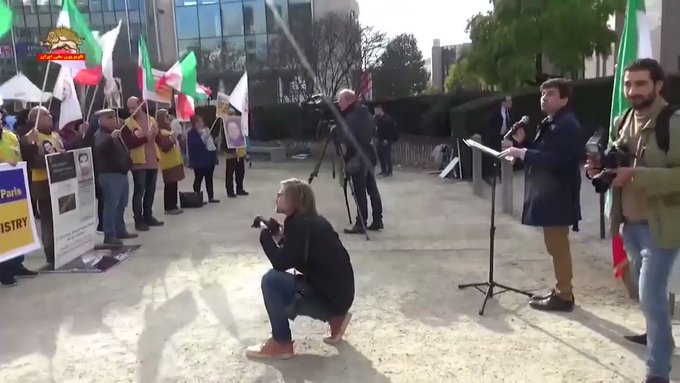
Members and supporters of Iranian opposition group, the National Council of Resistance of Iran (NCRI) held a demonstration in front of the European Commission in Brussels on Monday to call for Iran’s Ministry of Intelligence to added to the European Union’s terror black list; four months after an Iranian plot to blow up an opposition rally in Paris was foiled by European authorities.
In early October, French officials said that they had “no doubt” that Iran’s Ministry of Intelligence was behind the plot to attack the rally, especially after Iranian diplomat Assadollah Assadi was arrested for planning the terrorist attack.
Paulo Casaca, a former member of the European Parliament, said: “I was among the people who were there on June 30. So I can say that, even personally, I have a case here to the European External Action Service (EEAS) and there has not been a single word from the EEAS on the issue.”
The protesters also condemned the EU for remaining silent on mass executions, human rights violations and repression of women in Iran.
NCRI member Firouz Mahvi said: “We expect EU today to break the silence. We want EU to be active and to be on the side of Iranian people.”
London
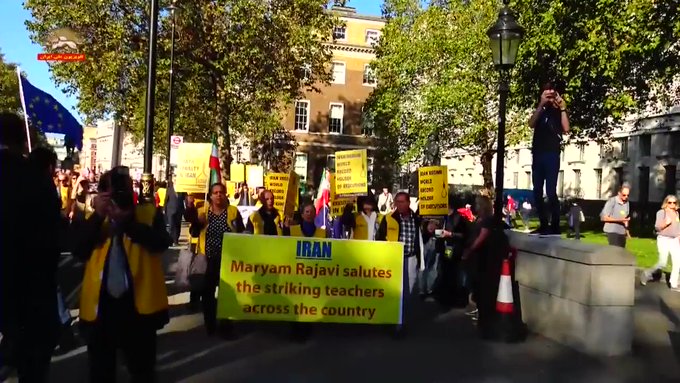
The NCRI also held a protest in Downing Street on Saturday to draw attention to the human rights abuses of the Iranian Regime and hopefully encourage Prime Minister Theresa May to put more pressure on the Regime.
The protesters chanted slogans advocating for the overthrow of the Iranian Regime, including “Down with Rouhani! Down with Khamenei!” and “Change! Change! Change! Regime change in Iran!”.
The NCRI and Amnesty International report that Iran executed over 500 people in 2017 alone – accounting for almost 60% of the region’s overall executions – and that at least 31 took place in public. The NCRI also revealed that the Iranian Regime executed more than 30 people in September and at least five juveniles during the first half of 2018.
Further, the Iranian opposition said that over 70 people who supported the ongoing truckers’ strike in Iran have been arrested and threatened with execution.
The event featured a number of speakers who addressed the crowd about human rights abuses in Iran.
Dr Jocelyn Scotts condemned Iran’s use of the death penalty and torture and noted that the Iranian people are protesting against this brutality.
While NCRI supporter Naghmeh Rajabi said: “There needs to be more pressure to bring a halt to all of these executions, especially the public hangings that are happening.
Children, people, normal people are walking in the streets and they see bodies hanging from cranes. That’s kind of becoming a normality in Iran and it is completely unacceptable in the twenty-first century.”
She advised that if the UK was going to keep doing business with Iran, then it should take action against its human rights abuses, but that the best solution would be regime change.