‏نمایش پست‌ها با برچسب Workers. نمایش همه پست‌ها

۱۳۹۷ آذر ۷, چهارشنبه

Haft Tapeh Rises Up For Its Rights

Haft Tapeh rises up for its rights

Since three weeks ago the Haft Tapeh Sugar Cane Mill’s hard-working workers gathered in front of the governorate office in Shush south of Iran.
Youths, students and workers’ families participated extensively in the demonstrations. Women played a significant role at the forefront.
On Saturday, November 17, 2018 a massive demonstration took place in spite of repressive measures and the creation of a climate of fear and terror, including the presence of scores of the special anti-riot and other repressive forces in the police station, governorate and the city.but when the workers did not stop the strike, the suppressive forces arrested and detained some of them.
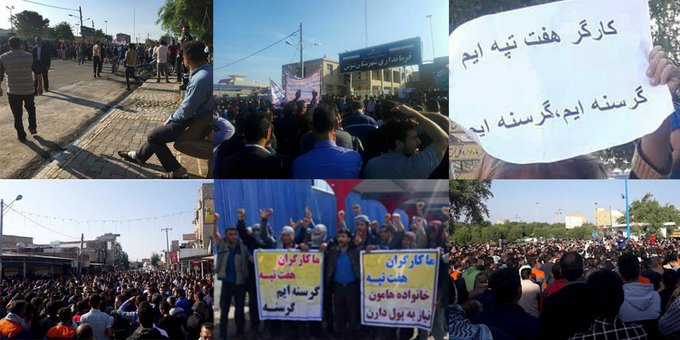
At the November 6 demonstration, the protesters chanted:“We are workers of the Haft Tapeh, we are hungry, hungry”, “Down with the oppressor, hail to the worker”, “Worker dies but does not accept humiliation”, “One less embezzlement, our problem will be solved!”, “The betrayal of the authorities must be disclosed”, “We do not want deceptive ”, “Government, embezzler, happy marriage!”
Protesters, including students, carried handwritten banners reading:
“We are children of Haft Tapeh, we are hungry”, “Dad gave water, dad gave bread, is no longer our slogan; but dad gave his life”, “We do not want false promises, we want our rights.”
Mrs. Maryam Rajavi, the president-elect of the National Council of Resistance of Iran (NCRI) saluted the striking workers of the Haft Tapeh Sugar Cane factory and Ahvaz National Steel Group and said:
“Shush has risen with the cries of workers, and solidarity and strike of youth, teachers and merchants of the bazaar. The enemy attempts in vain to silence the Haft Tapeh deprived workers by suppressing and arresting them, but the cry of “we are hungry, hungry” of the children of Shush, calls the conscience of every human being to rise up against the oppressor mullahs…
The enemy tries in vain to silence the voice of the deprived workers of Haft Tappeh through arrests and suppression. The cries of “we are hungry” of the children of Shush awaken the conscience of every human being, provoking them to rise up against the oppressive mullahs.
486 people are talking about this
Mrs. Maryam Rajavi, the president-elect of the Iranian resistance also hailed the determination of the oppressed hard-working workers of Haft Tapeh sugar cane factory and Ahvaz National Steel Group, and other strikers across the country, and called on fellow citizens, especially the youths, to support them and said:
“Poverty, inflation, unemployment and corruption were brought to our country by the religious fascism, and will continue as long as this medieval regime is in power.”
Formerly Mrs. Rajavi had addressed the truckers and marketers on strike in her messages as:
“For as long as the criminal and corrupt mullahs are in power, high prices, recession and poverty and the path to environmental destruction will continue; the only solution to this national crisis is the establishment of democracy and popular rule.”
in ,
National Steel Group employees protesting delayed paychecks and rallying against regime officials.
Chants:
"Government, ; congratulations on your unity"
"We steelworkers stand against cruelty & oppression"
November 24 in ,southwest
National Steel Group employees protesting delayed paychecks and rallying against regime officials
Chants:
"Down with this deceptive government"@nikkihaley @StateDept @eu_eeas @FedericaMog pic.twitter.com/7NH8DEqbBy
See Iran Freedom-En's other Tweets
Maryam Rajavi has described the nationwide strike by bazaar merchants and truck drivers as a part of the people’s uprising with the goal of overthrowing the regime and establishing freedom and social justice.
She had said under the mullahs’ regime, the wealth of Iran‘s people, which should be spent on economic improvements and people’s prosperity, is wasted on suppression and export of terrorism and external wars and is stolen by the ruling mullahs.

Achievements of Haft Tapeh Workers So far:

The movement of the Haft Tapeh workers and their achievements, regardless of any gimmicks represented by the regime, to confront it is registered in the record of the national uprising of the Iranian people and the history of the rightful movements of our homeland’s workers.
The uprising of Haft Tapeh workers has succeeded in bringing many similar demands to confront privatization in other areas up front. The demands that have been hiding under the ashes of oppression and disappointment.
Now, by following this example students and even hospital staff are protesting the privatization of education and medical treatment.
In the next step, these demands are immediately upgraded to a higher and more fundamental change.
And in this way, the guild related demands will lead to the most political demands, just as the demonstrations in December 2017 and summer of 2018 quickly became political and targeted the head of the mullahs’ regime.

۱۳۹۷ آذر ۲, جمعه

Haft Tapeh workers’ perseverance and solidarity brings the Iranian regime to its knees

Protests by workers of Haft Tapeh sugar mill

In response to widespread demonstrations and support for the Haft Tapeh workers’ cause, the Iranian regime was forced to back down and release all the imprisoned workers on bail, except two of their leaders.
Haft Tapeh Telegram channel, the official channel for Haft Tapeh’s sugar worker association, was first to announce the release of the workers on November 19. It says that all the detained workers, except for four of the workers’ representatives (including Esmail Bakhshi, Mohammad Khanifar, Moslem Armand, and Seyed Hassan Fazeli), have been released. Previously the workers had said that they will continue to protest until all the detainees are set free. Regime officials later released three of the remaining prisoners. Bakhshi and a civil rights activist remain in prison.
As always, when we face such a move by the Iranian regime, it begs the question, does it signal the Iranian regime’s power and stability or its fear of more protests and its weakness.
Haft Tapeh workers’ protests has led to widespread demonstrations, protests, and solidarity acts across the country, including among the steel workers of Ahvaz and university students in Tehran.
In its editorial about the Haft Tapeh worker protests, state-run Resalat newspaper writes: “The protests of sugar factory workers in Shush’s Haft Tapeh have now become a symbol and Haft Tapeh has become a national issue.”
The newspaper warned Rouhani’s government about the consequences of a continued protest and writes: “Considering the sanctions and the government’s weaknesses in the manufacturing sector, we predict that such incidents and protests will increase, and the government and media have to come up with a solution to manage them.”
“If we don’t learn our lesson from this incident and amend our approaches, it can lead to unsolvable difficulties for the country,” the newspaper further warns.
The situation is so bad that state-run media can’t help but acknowledge the workers’ legitimate demands. In another report Resalat writes: “The Haft Tapeh issue isn’t only about the remaining payments of the workers. It also includes things like the lack of transparency in privatization, the workers’ insistence on returning the factory to the public sector, and also corruption and the escape of the factory’s management.”
Shady privatization procedures of publicly owned companies have been a long-standing issue of controversy in Iran. In essence, former public companies are handed out for ridiculously low prices to relatives of high-ranking officials or IRGC members while the whole process is branded as privatization to the public. This is one of the pillars that, over the last three decades, has led to the current kleptocracy and fatally ill economy in Iran.
ILNA, an Iranian state-run news agency, quotes a lawyer and warns about the consequences of a violent crackdown of the workers: “Unfortunately, the harsh living standards of employees has reached a situation where these hard working people of the society can’t afford their basic needs and can’t help but to protest… therefore, a violent response to social protests won’t work at all.”
Sadegh Zibakalam, a so-called moderate who is very much concerned for the future of the Iranian regime, writes in his Twitter feed sarcastically: “For some officials and authorities in Iran, the efficient way to deal with many social problems, is to erase the problem [in the first place]. If students are protesting, school teachers have no option but to strike, the workers of Haft Tapeh sugar factory haven’t received their paychecks for months and are tired to their bones and in similar cases, you can just handle the situation by detaining the leaders.”
If there is one thing that the Iranian people have learned over the past four decades, it is that the Iranian regime only understand the language of perseverance and resistance and will only act properly if it sees the entire regime endangered.
Watching moderates and conservatives advise caution in handling the Haft Tapeh situation is all it takes to understand the precarious pass the Iranian regime finds itself in.
Decades of self-inflicted economic mismanagement and corruption in addition to economic sanctions and high costs for foreign adventures, has alienated even the communities on whose support the Iranian regime has traditionally counted.
In some Friday prayer ceremonies, regulars of the prayer sit with their backs to the prayer leader, who represents the regime, and make one of the most profound political statements possible by saying “back to the enemy face the country.” It’s also very cleverly done because the Iranian regime is tied-hands when it comes to cracking down on these people.
Let’s pray for those real prayers who thus endanger themselves by speaking out against the most corrupt theocracy in the world and hope that the Iranian people will see democracy and freedom soon.

۱۳۹۷ آبان ۲۹, سه‌شنبه

HAFT TAPPEH SUGAR CANE WORKERS' DEMONSTRATION, WIDELY ACCOMPANIED BY PEOPLE, FAMILIES AND STUDENTS OF SHUSH

Strike of Ahvaz steel workers with the slogan of Unity, Unity!

On Saturday morning, November 17, the Haft Tappeh Sugar Cane Mill hard-working workers gathered in front of this complex and marched to the governorate office in dense ranks. Young people, students and workers' families participated extensively in the demonstration. Women played a significant role in front of the demonstrators. This massive demonstration took place in spite of repressive measures and the creation of a climate of fear and terror, including the presence of scores of the special anti-riot and other repressive forces in the governorate and the city.
The protesters chanted: “We are workers of the Haft Tappeh, we are hungry, hungry”, “Down with the oppressor, hail to the worker”, “Worker dies, does not accept humiliation”, “One less embezzlement, our problem will be solved!”, “the betrayal of the authorities must be announced”, “we do not want incompetent officials”, “Government, embezzler, happy marriage!”
Protesters, including students, carried hand written banners reading: "We are children of Haft Tappeh , we are hungry”, “Dad gave water, Dad gave bread, is no longer our slogan; Dad gave his life”, “We do not want false promise, we want our rights.”
In their protest to unemployment, poverty and hunger, workers symbolically put up empty tables in front of the market and the governorate.
Representatives of the workers protested in their speeches to the anti-workers' plans of the regime and the assignment of this economic pole of the country to the plunderer gangs affiliated with Jahangiri, the first deputy of Rouhani, and emphasized the need for continued protest to achieve their rights.
At the same time, Ahvaz Steel hard working workers, who last week went on strike to protest non-payment of their four months' salaries and benefits, once again gathered in front of Khuzestan governorate in Ahvaz and then march to the city governorate office. They called for payment of their arrears, setting up production lines, and guaranteed occupational safety and payback. They chanted: “Steel, Haft Tappeh, Unity, Unity; Neither threats nor prison has no longer any effect; Lest we accept humiliation; No nation has seen this much injustice; Down with this deceiver government; Our enemy is here, they falsely say it is the United States.”
Maryam Rajavi, saluted the women leaders in the passionate demonstration of Haft Tappeh workers on Saturday who cried freedom and justice by chanting "Worker dies, does not accept humiliation”, and said: "Leadership of women in the strikes of Iranian teachers and workers is a pride and flares up the flames of uprising and justice.” She called the voices of the brave strikers of Haft Tappeh and Ahvaz Steel as a voice for the freedom and justice of the Iranian people, calling on all young people to support these leading workers. She urged all international human rights organizations and trade unions around the world to support the striking workers in Iran.
Secretariat of the National Council of Resistance of Iran
November 17, 2018

۱۳۹۷ آبان ۱۰, پنجشنبه

Workers, farmers protesting & on strike in numerous cities across Iran

Various images of many strikes & protests launched by Iran’s workers & farmers

With each passing day more cities of Iran are witnessing escalating protests and strikes launched by people from all walks of life.
Employees of the Farabi petrochemical site in Bandar Mahshahr, southern Iran, are continuing their rallies on Wednesday, protesting the fact that their demands have not been met and various other plans are being blocked by site authorities. These workers are now on strike for the third time since March and are holding numerous protest rallies. In this latest round of protests, now ongoing for ten days, these workers are demanding factory officials respond to their demands regarding inadequate and at times extremely poor working conditions.
Employees of a power plant in the city of Kashan, central Iran, are on strike on Wednesday, protesting the fact that they have not received their paychecks since March.
Farmers in the cities of Isfahan, Lenjan and Najaf Abad are also holding vast rallies, protesting officials’ measures to deprive them of their share of river waters for their lands.
Farmers in the town of Lenjan and the vicinity rallied on Wednesday at the city center, demanding authorities provide them their share of river waters.
Farmers in Najaf Abad continued their strike for the fourth consecutive day on Tuesday, protesting lack of water for their farms.
Read more:
As reports of continuing protests and strikes arrive from across Iran, clients of the Caspian credit firm, associated to the regime’s Revolutionary Guards (IRGC), rallied outside this institution’s main office building in Tehran and held a protest gathering on Monday morning.
“Caspian has stolen from us, the government is supporting its measures,” the protesters were chanting.
Alborz Nahal Neshan credit company clients demanding their stolen savings returned
Alborz Nahal Neshan credit company clients demanding their stolen savings returned 
Also on Monday, clients of the Alborz Nahal Neshan credit company protested outside the Bank Keshavarzi in Tehran, demanding their plundered life savings returned.
In Javanrud, western Iran mobile street vendors selling fruits rallied outside the mayor’s office in this city on Monday, protesting the rising price of fruits.
Protest in Javanroud
Farmers in Najaf Abad, Qahderijan and Fouladshahr of Isfahan Province, central Iran, began rallying again on Monday, protesting and going on strike for not receiving their share of river waters. A large banner seen at their protest site read, “What happened to our Zayanderud (a local river)?”
Farmers in the city of Shushtar, southwest Iran, also rallied on Monday, protesting not receiving answers to their rightful demands. They parked their tractors in one area in a sign of their ongoing protests.
In Abadan, southwest Iran, a group of contract employees in the Abadan oil refinery’s transportation sector held a rally demanding their delayed paychecks and pensions.
On Saturday, various posts on official outlets and social media networks indicated numerous groups of rail workers going on strike, continuing to this day. The state-run ILNA news agency, along with other outlets, were also posting reports in this regard.
As this strike successfully began, Iran’s society is now witnessing yet another group of workers launching a strike. These rail workers are responsible for keeping the country’s rail network up and running 24 hours a day, seven days a week.
This latest series of strikes in the third round of protests launched by Iran’s rail workers in the past six months. It is worth noting that the rail workers also launched a number of more local strikes in between the periods when the entire country was experiencing strikes.
The protesting rail workers are demanding delayed paychecks, in some cases postponed for three to four months. Cities across numerous provinces, including Khorasan, Azerbaijan, Lorestan, Isfahan, Zanjan, Eslamshahr, Karaj, Shahroud, Semnan, Damghan, Gorgan, Varamin, Arak, Urmia (Orumiyeh), Andimeshk, Zahedan and the town of Diezel near Tehran were home to such protests.
On September 29, rail workers in Shahroud began demanding their delayed paychecks. Once again, on October 6, rail workers in Khorasan Province went on strike, marching towards the mayor’s and governor’s office while protesting their delayed paychecks.
Officials have repeatedly provided hollow promises saying the workers’ demands will be provided for. This has become nothing but hollow promises. These workers have also not received their wages for the past few months or any pensions during the past six years. Only 22 rail workers in Tabriz have been able to receive their pensions.
All the while, inflation is skyrocketing, necessities are becoming more expensive with each passing day, and the workers are being deprived of even their very low incomes.
Protesting rail workers on strike in Iran
Railway workers in various parts of Iran, including Hormozgan, Shahroud, Damghan, Semnan, Zagros, and Lorestan launched their third round of protests on Saturday morning, demanding their paychecks that have been delayed for the past three months.
This is yet another example of people from all walks of life protesting in cities across Iran.
These workers, numbering at around 6,500, are saying they are very steadfast and serious on this new round of protests.
Their first rally dates back to July 20th to August 8th. The second round was launched on August 25th, continuing for three days.
These protest gatherings were held in various rail networks throughout the country, including the provinces of Khorasan, Azerbaijan, Lorestan, Isfahan and Zanjan, and the cities of Eslamshahr, Karaj, Shahroud, Semnan, Damghan, Gorgan, Varamin, Arak, Urmia (Orumiyeh), Andimeshk, Zahedan and Diezel near Tehran.
On September 29th, rail workers in Sharoud went on strike and launched a protest rally after not receiving answers to their demands.
Workers of the Abnie Company are seeking permanent contracts, an independent worker union, job security and measures preventing officials from launching unbridled layoffs, being permitted to voice their protests and discuss their demands, monthly paychecks provided at specific timings and the workers’ insurance problems seen to for their ultimate resolving.
Negligence to the workers’ demands have resulted in their problems remaining unresolved over the years, and the workers continue to seek their fundamental demands.
Repair employees of Tehran’s railway have joined the general rail workers’ strike, saying they are demanding a raise according to legal regulations.
The protesting workers issued a statement saying:
“We have not received our demands and pensions at a time when we are facing an increase in prices of ordinary goods on a daily basis and we literally lack the ability to provide for our basic needs.”
The workers are demanding their paychecks being provided on time through a regular trend.
“We railway workers are among the most deprived branch of society and the wages we are from contracting companies are provided at a very minimum. In the best of circumstances, a railway worker is receiving 15 million to 17 million rials a month ($107 to $121). Most of this goes to provide for the mortgage, water, electricity, and gas. Even if we are able to pay for these expenses, it will be through extreme difficulties and even further dilemmas will come our way.”

۱۳۹۷ مرداد ۹, سه‌شنبه

Widespread protests and strikes by the workers of Tabriz railroad

Protest gathering of the Tabriz railroad workers, July 30, 2018

 After not having received their wages for months and having received no answer from the Iranian regime’s authorities, the workers of Tabriz’s railroad gathered in the railroad station on Monday and started a demonstration and a strike. Tabriz’s railroad workers have joined workers in other cities of Azerbaijan province, including Qazvin and Zanjan, who have been on strike in the past days.
The strikes are not limited to the railroad of Azerbaijan and is also ongoing in other parts of Iran. In the past six days, railroad workers in Lorestan, Neyshabur, Damqan and Khoramshahr have also been on strike.
Demonstration by Tabriz railroad workers, July 30, 2018
Some of Iran’s cities where railroad workers have been protesting include the following:
  • In Zanjan, railroad workers went on strike since last week
  • In Neyshabur, the workers blocked the railway on July 28
  • In Sharafkhaneh, Azerbaijan, railroad workers have been on strike since last week
  • In Zaheda, Baluchistan, railroad workers staged a protest on July 26
  • Railroad workers in Eslamshahr, Karaj, Lorestan, Azerbaijan and Zagros staged demonstrations at the same time
  • Workers went on strike and closed down the railroad of Doroud on July 25
  • The workers of the northeast railway (Semnan, Shahrud, Damqan) went on strike on July 25
  • Railroad workers in Tabriz, Sufian, Ajab Shir, Marand, Salmas and Shafakhaneh went on strike on July 25
  • In Andimeshk, railroad workers went on strike on July 24
  • In Eslamshahr, railroad workers went on strike on July 23
Tabriz railroad workers strike
Tabriz railroad workers strike 
In Tabriz, the protesting workers, who have been dealing with unpaid wages, increasing difficulties at work and no response to their requests, spent the night at the railroad company’s building. They have also refrained from going to work on the next day.
In Sharafkhaneh, Western Azerbaijan, the workers refrained from going to work at a new construction site.
In comments to a local news outlet, one of the workers said, “Today, Monday, is the sixth day of the widespread strike of the railroad company of Azerbaijan. In dialog with the workers, the railroad authorities promised to pay pending wages by July 27, but to date, there’s been no payment.”
The worker added, “Yesterday, the workers of Sharafkhaneh refrained from going to work at a new construction site in protest to their unpaid wages.”
In parallel to protests and strikes in Azerbaijan, railroad workers in other parts of Iran are also staging protests.

۱۳۹۷ اردیبهشت ۵, چهارشنبه

Iran: protest gathering in Rasht, Ilam


Iranian workers stage a protest act outside Qazvin governor's office
workers of the Ilam Pertochemical Company, in southwestern Iran, gathered in protest against a breach in their contract and layoff of workers by the company.


In Rasht, north of Iran, workers of the Ashimashi Company, staged a protest gathering in front of the Labor Office to show their objection to work conditions.

۱۳۹۶ اسفند ۱۷, پنجشنبه

Continued strikes of workers and the working people, and protests of looted people and other deprived people


National Council of Resistance of Iran

1. The general strike of the workers of the Haft Tapeh Sugar Cane Company, including the workers of the agricultural, equipment and engineering sectors, continued for the second day. The Haft Tapeh Sugar Cane Workers Syndicate announced on Sunday, March 4, that after the suicide of Ali Naqdi, a deprived cane cutter, the salaries of the workers for the month of January have been paid. But the salaries of other workers of other parts of the factory, as well as February salaries and the benefits and bonuses of the end of the year, have not yet been paid. 
2. The workers of the Ahvaz Steel National Group continued their strike in front of the Ahvaz Governorate for the thirteenth day. They chanted: We stand, we die, we get our rights. On Monday evening, a group of workers and families and relatives of detained workers gathered in front of the Ahvaz court. 
3. More than a hundred U-TA-TEC workers from the southern oil and gas industry in Bushehr went on strike in protest of their unpaid demands that are between one and seven million tomans (~ $200-$1400) per worker. The corporation, which belongs to the Revolutionary Guards Corps, continuously threatens to expel and arrest the deprived workers. Workers are protesting late wage payment, situation of dormitories, and the lack of minimum essential services. 
4. Tabriz railway workers stopped working for the second day in protest of not getting paid their wages and refusing their official recruitment. 
5. Hundreds of deprived farmers of Varzaneh in Isfahan, who have been protesting the regime's refusal to give their water rights since a few days ago, gathered in front of the Benroud Province. They say the clerical government has promised them lies and the governor does not do anything for the farmers. 
6. A group of Haftgel de-salting workers protested against the regime's governorate. 
7. Workers of the vegetable oil factory of the industrial city of Shourmast of Savadkouh gathered in the factory to receive their five months' unpaid salary. 
8. Khorramshahr Municipality workers gathered to protest against non-payment of their six months' salary in front of the office of Khamenei’s representative. 
9. Fuel carriers gathered in Tehran in protest of the monopoly on the distribution of fuel to the regime's dependent companies in front of the regime's oil ministry. 
10. Workers of the Gorgan municipality's outbound and underground projects gathered to receive months of unpaid salaries at the Gorgan City Council. 
11. Ghaemshahr textile workers continue to protest because they did not get paid for three months of salary. 
12. The workers of the Tehran and Suburbs Bus Company, on the twenty-second day of their protest, chanted in front of the Tehran City Council: Mayor, be ashamed, think about us! the workers are awake, they hate thefts; one less embezzlement, our problem will be resolved. 
13. Workers at the Hafez Tile factory in Zarqan in Fars province, called for payment of their several months’ unpaid salary by gathering in front of the factory. 
14. The merchants and shopkeepers in Jolfa objected to not releasing their goods and causing damage to them in the office of the Assistant Economic Directorate of Aras. On the eve of Nowruz they are deprived of being with their families due to poverty and can not provide for their livelihoods. 
15. Those who were approved by the Ilam Agriculture Supervisory Board and have completed all legal procedures for recruitment, gathered in front of the governorate of the city due to the failure to recruit them and their deteriorating livelihoods. 
16. A group of looted people at the Vali Asr Institute in Nasim Shahr, Tehran province, demanded that their deposits be returned. 
17. Merchants of the city of Daran in Isfahan Province gathered to protest the economic turmoil. 
Secretariat of the National Council of Resistance of Iran 
March 6, 2018