‏نمایش پست‌ها با برچسب US. نمایش همه پست‌ها

۱۳۹۷ آبان ۲۴, پنجشنبه

Latest US Sanctions, Highlight The End Of The Appeasement Policy

Latest US sanctions, highlights the end of the appeasement policy

A statement by the White House, issued on November 2, 2018,    provided more details. It promised that the latest US sanctions would be the toughest that the Iran regime has experienced so far.
U.S. Secretary of State Mike Pompeo and Treasury Secretary Steven Mnuchin stated that the latest US sanctions would target the Iranian regime’s shipping, financial and energy sectors. The U.S. officials also declared that the oil exports, which account for the funding of the most of the regime’s illicit activities, would be the biggest focus of the new sanctions. Moreover, 700 companies, individuals, businesses, aircrafts and ships were added to the latest US sanctions list and were blocked from accessing global business and financial networks.

The latest US sanctions also target transactions with the Central Bank of Iran and designated Iranian financial institutions.

According to the Treasury Secretary, Steven Mnuchin, the international banking organization, SWIFT, should cut off sanctioned Iranian banks as soon as it’s technically possible. “It is our intent that they cut off designated entities as was done before,” he said.
The U.S. intends to fully enforce all the sanctions on Iran, and those who attempt to skirt them will risk severe consequences.
Foods, medicine, medical devices and agricultural commodities are excluded from the sanctions.
The latest US sanctions are targeting those revenues the Iranian regime uses to fund its weapons of mass destruction program, its destabilizing policies to fuel regional conflicts and support terrorism, and they also aim at cutting off the sources that feed the kleptocracy system ruling Iran.
Secretary of State Mike Pompeo said: “It is aimed at depriving the regime of the revenues that it uses to spread death and destruction around the world.” He added, “Our ultimate aim is to compel Iran to permanently abandon its well-documented outlaw activities and behave like a normal country.”
The US hopes that the latest US sanctions will bring the Regime back to the negotiating table for a new deal, which addresses its malign behavior, including support for terrorist groups and use of ballistic missiles.
Brian Hook, the U.S. Special Representative for Iran explained: “Our maximum economic pressure campaign is designed to deny Iran the revenue it needs to support terrorism and missile proliferation and to bring them back to the negotiating table so the president can negotiate a much better deal.” Hook continued, “We intend to seek a new deal with Iran that addresses the entire range of Iran’s threats to peace and security.”
In Iran, the officials are trying to downplay the effects of the sanctions. Eshaq Jahangiri, the first vice president under Hassan Rouhani, stated that he did not expect Iran’s economy to be impacted much by the latest US sanctions. But it did not take too long before he admitted: “I would have lied if I said that the sanctions have no impact. U.S. sanctions have negative impact on the country’s economy.”
On November 9, Alam-Al Hoda, Imam of Friday prayers in Mashhad, and the representative of Khamenei stated that they had a 40% stagflation, which was destroying the economy.
But the regime’s officials were incapable to explain about the people’s exasperation at the dire economic situation. The situation that brought the people into the streets at the end of the last year and caused a nationwide uprising which has been continuing ever since.
Indeed, by appeasement policy being over, and after the uprising of the Iranian people with the demand of regime change, the latest US sanctions are going to choke the Mullahs’ financial resources, which in turn leads to decreasing regime’s capability of oppressing people, those who chanted on the streets of Iran: “Our enemy is right here; they are lying that it is America!”; “Let go of Syria, think about us” and “Khamenei lives like gods, while the people live in poverty.”


Related article to the latest US sanctions

Sanctions Are Not The Ultimate Solution; Recognize The Iranian Resistance
How Does US Sanctions Weaken The Iranian Regime By Launching The Iran Task Force?
MEK, A Challenge Much Bigger Than US Sanctions For Iran Regime
Re-Imposing Sanctions Against Iran’s Regime Is An Undeniable Necessity
Who Is The Basij Force Targeted By The US New Sanctions?

۱۳۹۷ مرداد ۳۱, چهارشنبه

How Does US Sanctions Weaken The Iranian Regime By Launching The Iran Task Force?

 How does US sanctions weaken the Iranian regime by launching the Iran task force?

 “Our enemy is here; they (Iran’s leaders) lie when they say it is America.” By this slogan the Iranian protesters responded to Hassan Rouhani’s remarks following the US sanctions,  of which he said are against the Iranian people.
The shattered economy of the Iranian regime has been thwarted by US sanctions in a massive turbulence. And while there is no rescue shore for it, The Mullahs are between a rock and hard place of Iranian resistance, popular demonstrations  and US economic sanctions.
After the abolition of economic sanctions by Obama and the European governments, the Iranian regime spent $1.8 billion for terrorism and the wars in Syria and Yemen.
While the Iranian people were heavily under economic pressure, the mullahs spent the money supporting terrorist groups like Hezbollah in Lebanon and the Houthis in Yemen and Iraqi militias.

What can launching the Iran task force do?

Launching the Iran task force monitoring US economic sanctions, for many reasons can have a weakening effect for the Iranian regime.
Economic sanctions alone cannot weaken the regime, but the financial resources that the Iranian regime has accessed through oil.  Those will be cut and the mullahs will no longer be able to use the terrorist groups to advance their goals.
The Iran task force is an appropriate mechanism that prevents the Iranian regime cheaters from circumventing the sanctions.
The ruling regime in Iran is a religious dictatorship, not an ordinary government. We are talking about a regime that over the past four decades, has kept its rule in three ways; Internal repression, nuclear project, and interference in other countries affairs under the banner of the issuance of the revolution, the issuance of terrorism and religious fundamentalism, which show that the mullahs simply do not change their behavior.
Considering that the mullahs have not been able to reach the atomic bomb, they have increased their terrorist activities, and now  after US economic sanctions, the resources of the Iranian regime’s support for terrorism are not enough.Therefore the exertion of terrorism and fundamentalism have received a major blow, and there is only one lever left for the Iranian regime.

Internal repression:

Internal repression was another lever (instrument) that the Mullahs regime used to continue their own rule, but this method has lost its effectiveness since the beginning of 2018. Although the Iranian regime still uses an iron fist to suppress anti-government protests,   people are no longer afraid of repression, and by chanting slogans such as “Nor Gaza either Lebanon” “My life for Iran”, “Let go Syria think of us”, “Our enemy is here“ they (Iran’s leaders) lie when they say it is America. They are not only opposed to the mullahs’ terrorist interference, but by chanting slogans “death to dictator” they demand their overthrow.
Economic sanctions alone cannot be able to overthrow the mullahs’ regime but they strengthen the Iran’s people in toppling the theocracy in Iran, by the help of their own opposition, the National Council of Resistance of Iran.
Finally it should be said that the launching Iran task force is good but not enough, and the regime’s overthrow will only be achieved by the Iranian resistance and the people of Iran.

Related:

Outcomes Of Popular Iran Uprising, An Unstable Regime
MEK, A Challenge Much Bigger Than US Sanctions For Iran Regime
What Is The Basic Cause Of Anti-Government Protests In Iran?

۱۳۹۷ تیر ۲, شنبه

EU choosing Iran over the US is illogical, to say the least

European Unoin flags

Following the U.S. President Donald Trump’s decision to exit from the highly flawed Iran nuclear deal, formally known as the Joint Comprehensive Plan of Action (JCPOA), the European Union is striving to somehow safeguard the pact. EU’s main objective appears to be further normalizing trade and economic relations with Tehran.
This is already sending influential signs to other global parties, indicating the EU has chosen to side with the Iranian regime and not the U.S., and as a result not the Iranian people. While the Trump administration is reinstalling sanctions against the mullahs’ regime and warns further and more effective measures are in the making, Brussels continues to only take its short-term economic benefits into consideration.
U.S. Secretary of State Mike Pompeo – making significant noise recently with four tweets focusing on the Iranian regime in a mere 36 hours – specifically made it clear that Tehran would come under the “the strongest sanctions in history” if the mullahs refuse to alter their Middle East behavior that is wreaking havoc across the region.
The attempts made by the EU are unprecedented, as the bloc is seen appeasing the mullahs’ demands by succumbing to their economic and political demands. Iranian regime Supreme Leader Ali Khamenei is clearly listing new conditions for Tehran to remain loyal to the deal. Needless to say the regime’s Deputy Foreign Minister Abbas Araqchi has recently described the JCPOA as being in ICU and hinting the regime will likely be exiting the deal within weeks.
Khamenei has gone as far as demanding Europe to guarantee “Iran’s oil sales will not suffer, Tehran would resume enrichment activities that are currently prohibited.”
Certain is the fact that the EU will be considering the benefits of siding with Iran, while going against Washington’s wishes and being left to face the consequences. It goes without saying that the Green Continent’s relations with the U.S. is of strategic importance.
This political miscalculation by the EU will most definitely render significant setbacks for the bloc as the Trump administration remains steadfast on its firm policy vis-à-vis Iran’s rogue regime.
Unfortunately, what EU leaders are failing to understand is the fact that such a policy of siding with Tehran plays into the hands of Iran’s mullahs, causing a rift between the EU and the U.S.
Instead, the EU should be holding Iran’s mullahs responsible for their human rights violations at home and regional ambitions that has left millions in numerous countries suffering in misery.
Knowing the EU considers its partnership with the U.S. very dire, and the dismal $25 billion annual trade relation with Iran’s regime is nothing in comparison to the $600 billion exports to the US., the outcome is quite palpable.
Obvious is the fact that the EU’s interest lies in siding with the U.S., geopolitically, strategically, militarily and economically speaking.

۱۳۹۷ فروردین ۲۷, دوشنبه

Mission not yet accomplished… but a step in the right direction


US cruise missile strike on Syria

 Better late than never, they say. That dictum certainly applies to justice — and to the price the Assad regime must pay for crimes against its own people.
Were Saturday morning’s missile strikes enough? Absolutely not. That is why I disagree with President Trump’s declaration that this was “mission accomplished.” Is an invasion or a full-scale war the solution? Not at this stage; but the Assad regime has used chemical weapons before, and if not deterred, it would not hesitate to use them again.
Encouraged by the vacillating administration of Barack Obama, who seemed to believe that philosophy was an adequate substitute for action, Bashar Assad has been taking liberties since 2011. He has used every weapon in his arsenal — from bullets to barrel bombs, from torture to tear gas, from the merely cruel to the frankly barbaric, all with the assistance of Hezbollah mercenaries supplied by his allies in Tehran —to silence the demands of the Syrian people for freedom and justice. 
Meanwhile, the vacuum left by Obama’s dithering was filled by a Russian presence that tipped the balance in Assad’s favor. A fragmented opposition, and awful crimes committed by Daesh terrorists — many of them released by Assad from his own prisons for just that purpose — allowed the regime to claim the mantle of “the lesser of two evils.”
Missile strikes on the Assad regime signal that the days of actions without consequences are over — which is good to know when the carnage ends and the inevitable negotiations over Syria’s future begin.
Faisal J. Abbas
However, last week’s horrific chemical gas attack on Douma illustrated that Assad is so bloodthirsty, so lacking in basic intelligence that he could not even wait for his application to rejoin the human race to be approved. He may also be in denial of the fact that there is a new sheriff in town — one Donald J. Trump.
Indeed, how different is this US administration from that of its predecessor? Trump’s missile strike last year after Assad’s gas attack on Khan Sheikhoun should have been warning enough — but dictators never learn.
So now what? The strike has the potential to be a game-changer, not least because the US did not act alone. British and French forces took part in the attacks, while Saudi Arabia and other US regional allies are on board, having seen enough bloodshed in Syria — as will certainly be made clear at the Arab League summit in Dhahran.
Moreover, the anti-Daesh coalition has achieved significant results, and the terrorist group has never been weaker. The missile strikes on the Assad regime signal that the days of actions without consequences are over — which is good to know when the carnage ends and the inevitable negotiations over Syria’s future begin.
With Iran, an irrelevance in Syria, providing only logistical support to the regime, the only barrier on the road to a viable solution is Russia’s position. Moscow insists it is in Syria at the request of Damascus, and that its role is to prevent bloodshed and avoid the emergence of another Libya.
Since Russia appears to be going nowhere, let it serve some purpose. In 1962, John F. Kennedy defused the Cuban missile crisis and kept that whole region free of war. It happened in Cuba, it can happen in Syria — but to adopt a phrase, it takes two to salsa.
 
 FAISAL J. ABBAS

۱۳۹۷ فروردین ۲۶, یکشنبه

Destruction of several Hezbollah bases in Syria


Bases and areas belonging to the Hezbollah were among targets of the US attack on Syria

'Bases and areas belonging to the Hezbollah were among targets of the US attack on Syria. The Syrian army ammunition depot, 15 miles from the center of Homs, were bombed by 4 British jets,' the IRGC news agency, Fars reported
Military bases belonging to the president's guards corps and the Syrian army's 4th division in the vicinity of Damascus, responsible for the capital's protection, were also targeted.
'100 cruise missiles were fired at Asad's centers and military bases,' reported Fox News.
Russia's Department of Defense announced that none of the US airplanes entered Russia's air space, reported the Russian TAS news agency.

۱۳۹۷ فروردین ۲۵, شنبه

Top general: US did not notify Russia on Syria targets


The United States used its de-confliction phone line with Russia prior to Friday’s airstrikes in Syria

 The United States used its de-confliction phone line with Russia prior to Friday’s airstrikes in Syria, but did not tell the Russians what the United States was targeting, the U.S. military’s top general said Friday night.
“We specifically identified these targets to mitigate the risk of Russian forces being involved, and we used our normal de-confliction channels -- those were active this week -- to work through the airspace issues and so forth,” Joint Chiefs Chairman Gen. Joseph Dunford said at a Pentagon briefing. “We did not do any coordination with the Russians on the strikes, nor did we pre-notify them.”
Dunford was speaking alongside Defense Secretary James Mattis after President Trump announced at the White House that he ordered airstrikes against targets associated with Syria’s chemical weapons production.
The operation, done in coordination with U.S. allies Britain and France, was ordered in response to a chemical weapons attack last weekend that the United States and allies have blamed on Syrian President Bashar Assad.
Trump had sent a tweet on Wednesday warning Russia to 'get ready' for missiles headed toward its ally Syria and had spent days deciding on the exact response with France and the U.K. before the strikes took place on Friday.
Dunford’s comments Friday contrast with how the United States handled last year’s cruise missile strikes on a Syrian airbase. In that case, the United States used the de-confliction line to notify Moscow in advance.
Russia and the United States set up the so-called de-confliction line in October 2015 after Russian air forces intervened in the Syrian civil war to prevent each country’s forces from operating in the same area and thus clash with each other.
Asked repeatedly about de-confliction with the Russians on Friday’s strikes, Dunford maintained that the only communication was about airspace.
“The only communications that took place specifically associated with this operation before the targets were struck was the normal de-confliction of the airspace, the procedures that are in place for all of our operations in Syria,” he said. “We did not coordinate targets or any planning with the Russians.”
He said he was unsure how the Russians responded when the United States used the de-confliction line Friday, but claimed that Moscow probably did not find it out of the ordinary.
“That kind of information, to put it in perspective, is passed routinely every day and every night, so they may not have found anything unusual about that particular airspace de-confliction,” he said.
And while Syrian regime air defenses engaged during the strike, Dunford said he was “not aware of any Russian activity,” though he added more details might be available in the morning.
He also said the U.S. commander in Syria has changed the force protection levels for the 2,000 U.S. troops there fighting the Islamic State in Iraq and Syria (ISIS) in case of retaliation.
“As you can imagine, the commander always takes prudent measures, especially in an environment that we’re in tonight,” Dunford said. “So they did make adjustments.”

۱۳۹۷ فروردین ۱۳, دوشنبه

Storm brewing in Iran over nuclear deal, terror ties and domestic unrest


Former US ambassador to the United Nations John Bolton (L), a strong critic of Tehran, is now Trump’s National Security Advisor

  Recent developments are indicating a tough road ahead for Iran in what is promising to be a tumultuous summer.
U.S. President Donald Trump sacked his top diplomat, Rex Tillerson, on March 13, citing specifically differences regarding the Iran nuclear deal.
CIA Director Mike Pompeo, nominated to lead the State Department, favors a firm approach confronting Tehran’s regional policy and is a major critic of the Joint Comprehensive Plan of Action (JCPOA), as the Iran accord is formally known.
Former US ambassador to the United Nations John Bolton, a strong critic of Tehran, is now Trump’s National Security Advisor.
Prior to this, French Foreign Minister Jean-Yves Le Drian visited Iran on March 5, expressing concerns over Tehran’s ballistic missile program and Middle East belligerence. This portrayed the JCPOA’s fragile nature and Tehran’s failure to use Europe as a shield against the Trump administration.
Couple all this with escalating Iranian protests across the country, and the regime’s recent intention of filtering Telegram, a popular messaging app used by over 40 million people, and you have a recipe for disaster from Tehran’s perspective.  

Prelude 

Paving the path for Iran’s miseries, the Financial Action Task Force issued its latest report in February placing a June ultimatum for Tehran to input significant changes in its banking system and end financial relations with terrorist groups through nine specific procedures.
As Iran remains blacklisted in the financial market, investors are very hesitant over launching any meaningful project with the clerical regime.
Iran’s economic bankruptcy, parallel to widespread protests by people from all walks of life that continue as we speak, provide a very clear understanding about Tehran’s chief crises.

 Double impact

The groundworks of such circumstances are vivid in two very specific JCPOA weak points, from Iran’s perspective. While Europe lifted many sanctions, similar steps imposed by the U.S. remained considering how Congress disagreed with the Obama administration’s engagement with Tehran.
Obama used his executive authority to suspend nuclear sanctions, while non-nuclear sanctions imposed by the U.S., blocking America’s financial system to Iran. As a result, European banks are unable to get involved in dollar transactions with Iran.
This, again, leaves the JCPOA very fragile and allows Trump to annul the entire accord while financial & non-nuclear sanctions remain intact.

Underestimation 

Failing to comprehend the impact, Iran was boasting about Western companies lining up for business. This honeymoon ended quickly as Tehran came to understand its grave underestimation.
Former U.S. secretary of state John Kerry began receiving calls from his Iranian counterpart Mohammad Javad Zarif, seeking measures to set aside banking sanctions.
In March 20 16, Mohammad Nahavandian, then chief of staff of Iranian President Hassan Rouhani , travelled to London warning of unaccountable results if the JCPOA fails to resolve Tehran’s economic dilemmas. Maybe he was referring to the Iranian uprising where the poor flooded the streets and raised demands for regime change.  

Sweeping changes  

Iran’s economic predicaments continue as we speak, especially with the Obama years ending and the Trump administration executing sweeping changes in U.S. policy vis-à-vis Iran. Banks and companies across the globe, especially Europe, are showing cold feet in engaging with this regime.
Speaking at London’s Chatham House back in February, Iranian Deputy Foreign Minister Abbas Araghchi vividly voiced his regime’s concerns, complaining how Tehran is not fully benefiting from the JCPOA and describing the atmosphere as “destructive” resulting from Washington’s “confusion” regarding the nuclear pact’s future.
Iran also miscalculated the JCPOA as a green light by the international community to deploy the Lebanese Hezbollah and dozens of other Revolutionary Guards (IRGC) Quds Force-linked militia to not only massacre the Syrian people, but enjoy military presence in Iraq, Yemen and Lebanon.
From 2015 onward Tehran is significantly developing its ballistic missile arsenal, providing such an inventory to the Houthis in Yemen to target Saudi Arabia. All the while, Iranian officials continue boasting about Hezbollah’s missile capabilities.
In response, the U.S. Congress is continuously adopting sanctions targeting the Iranian regime’s belligerence, especially blacklisting the IRGC.
Another expressively sweeping change that proved Iran’s calculations completely came as Europe began distancing from Tehran. Iran’s JCPOA dream story is culminating, realizing Europe will never choose business with this regime over its strategic economic relations with the U.S.
European officials went to great lengths to have Iran curb its ballistic missile program and regional meddling in the face of Trump’s threat to exit the JCPOA.
This resulted in Iranian Supreme Leader Ali Khamenei and other senior officials adopting strong positions against France, expressing their discontent of Europe siding with the U.S.
“If we have maintained our missile range to 2,000 kilometers, it is not due to technological limitations… we will increase our missile reach to the extent which we feel threatened,” said IRGC deputy Hossein Salami in a state TV interview on November 26. 

Ultimate concern

While international isolation creates mounting quandaries for Iran, domestic unrest has forever been Tehran’s ultimate concern. To add insult to injury, Iran’s ongoing protests and uprising is under the navigation of the opposition People's Mojahedin Organization of Iran (PMOI/MEK). This coalition has for four decades been the main target of the Iranian regime’s onslaught.
Professor Ivan Sascha Sheehan in his recent article in The Hill says:
“Tehran’s violent reaction to peaceful protests demonstrates that the language of strength is the only language the regime understands. Even under current president Hassan Rouhani’s so-called ‘moderate’ leadership, the Islamic Republic continues its illicit activities to every extent it is permitted to do so.”
This is not a call to war. Quite the contrary. The world should acknowledge Iran’s current wars in Syria and Yemen, conveniently gone neglected by mainstream media and appeasement supporters.
The international community can best support the Iranian people’s uprising by crippling the regime’s entities, such as the Central Bank and IRGC. This goes analogous to recognizing the Iranian people’s organized resistance for regime change, symbolized in the PMOI/MEK.
An Iranian expression translate into “April showers bring May flowers.”
This spring is already promising a stormy summer for the Iranian regime and a year of historical developments for the Iranian people.

۱۳۹۶ بهمن ۲۷, جمعه

US wants UN action over report on Iranian missiles to Yemen


US Ambassador to the UN Nikki Haley -- shown here in December 2017 -- called on the UN Security Council to take action against Iran over its alleged activity in Yemen

US Ambassador Nikki Haley said Thursday that it was 'time for the Security Council to act' following the release of a report by UN experts concluding that Iran had violated the arms embargo on Yemen.
The report found that Tehran had failed to block supplies to Yemen's Huthi rebels of ballistic missiles that were fired at Saudi Arabia.
'This report highlights what we've been saying for months: Iran has been illegally transferring weapons in violation of multiple Security Council resolutions,' Haley said in a statement.
The ambassador added that 'the world cannot continue to allow these blatant violations to go unanswered' and that Tehran must face 'consequences.'
'It's time for the Security Council to act.'
Iran has strongly denied arming the Huthis and has accused Haley of presenting 'fabricated' evidence that a November 4 missile fired at Riyadh airport was Iranian-made.
Diplomats said the Iranian violations are likely to be addressed in a draft resolution renewing sanctions on Yemen that the council is set to adopt later this month.
It remains unclear however if Russia will back any move that punishes Iran.

۱۳۹۶ بهمن ۱۴, شنبه

Tough new sanctions on those who fund Hezbollah terrorism


W.H. press secretary Sarah Sanders announced news US sanctions on Hezbollah and Iran

 US White House press secretary, Sarah Sanders tweeted 'tough new Treasury sanctions today on those who are funding Hezbollah's terrorism. We will no longer allow corrupt Hezbollah and other Iranian regime cronies to hide their crimes behind front companies.'

۱۳۹۶ بهمن ۷, شنبه

Nikki Haley insisted on strong US Cyber defence


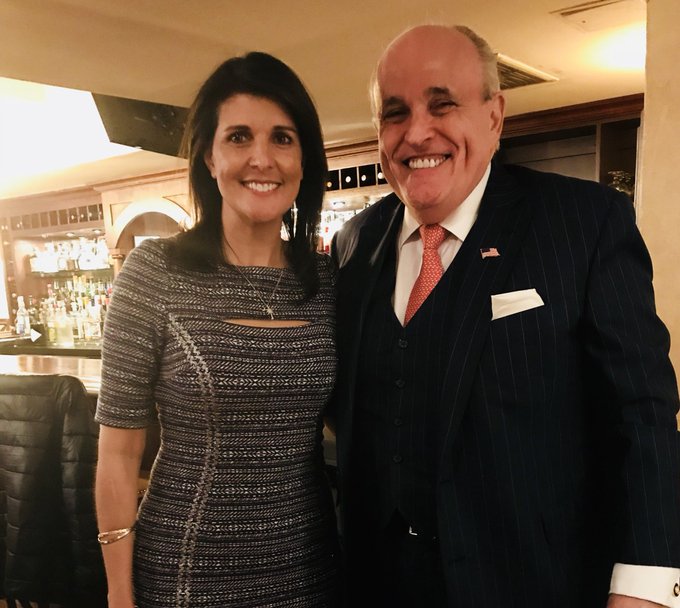
US Ambassador to the UN, Nikki Haley

Following a meeting with the America's Mayor, Rudy Giuliani, US Ambassador to the UN said via her tweet that 'Great meeting with America’s Mayor on security and cyber threats around the world. The US has to stay strong on all things cyber.'