‏نمایش پست‌ها با برچسب regime change. نمایش همه پست‌ها

۱۳۹۷ خرداد ۲, چهارشنبه

Iranian people’s uprising deserves global support

Iranian people demand regime change in Iran

 Shortly after U.S. President Donald Trump withdrew from the Iran nuclear deal, his Secretary of State, Mike Pompeo, delivering his first foreign policy speech, delivered a damning message to the Iranian regime and went as far as recognizing the Iranian people’s protests and uprising against the ruling regime.

Secretary Pompeo referred to major JCPOA flaws and the “blood money” offered to Tehran and Revolutionary Guards Quds Force (IRGC) chief Qassem Soleimani, while recalling United Nations Security Council resolutions reiterating any new agreement with the Iranian regime must include halting uranium enrichment, unhindered access to all nuclear sites, ending ballistic missiles proliferation and developing nuclear-capable missile systems, respecting Iraqi sovereignty parallel to disarming the Iranian regime’s proxy militia groups, withdrawing all Iranian commanded forces from across Syria, ending missiles launches and threats targeting its neighbors, and ending all support for terrorist groups in Afghanistan, Lebanon and Yemen.
Maryam Rajavi, President of the National Council of Resistance of Iran (NCRI), a broad coalition of Iranian opposition, issued a statement considering it a major step forward to recognize the Iranian people’s uprising and demands raised by their just resistance in the past 37 years.
“Change in the behavior of the mullahs will inevitably lead to the change of their regime. Democratic change in Iran is the only solution to the problem in Iran and the crisis in the region. Forming an international front against the religious and terrorist dictatorship in Iran is requisite for establishment of peace, security and coexistence in the region and world over,” she stressed.

Back in 2013 when the nuclear talks first initiated, on November 24 Rajavi underscored how full UNSC resolutions implementation, predominantly a complete halt to uranium enrichment, abiding by the Additional Protocol and providing IAEA inspectors unhindered access to all sites are essential for the Iranian regime to be approved of actually abandoning its nuclear weapons drive.
The July 2015 Iran nuclear agreement circumvented six UNSC resolutions through an unsigned agreement. That accord lacked the requirements of an official international treaty, and therefore failed to block the mullahs' deception and their access to obtain nuclear weapons.
The Joint Comprehensive Plan of Action, as the deal is formally known, provided Tehran money it went on to pour into its coffers. Strict United Nations monitoring must be established to ensure that Tehran’s mullahs address the Iranian people's urgent needs, and not those of terrorist groups across the Middle East.
Without such observance, Iranian regime supreme leader Ali Khamenei funneled this capital to further the regime’s terrorism and fundamentalism in Lebanon, Syria and Yemen, as well as fully providing for the IRGC.
The Iranian people have the right to now see their anti-regime protests recognized.  Any agreement disregarding and failing to underscore their human rights will only embolden the regime in its suppression and executions.
The Iranian people will no longer accept such an outcome and are taking matters into their own hands.

۱۳۹۷ اردیبهشت ۳۱, دوشنبه

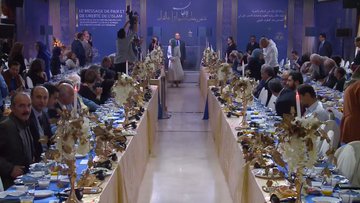
Ramadan conference in Paris supports regime change in Iran and peace across the Middle East

The Iftar conference held in Paris, France, titled “Islam’s Message of Peace and Freedom,

In an Iftar conference held in France titled “Islam’s Message of Peace and Freedom,” the Iranian Resistance and representative from different Muslim communities and Arab countries expressed solidarity with the Iranian Resistance, and support for regime change in Iran and the end of Islamic fundamentalism in the Middle East and across the world.

In her keynote address to the conference, Mrs. Maryam Rajavi, president-elect of the National Council of Resistance of Iran (NCRI), reminded that in Iran, the first day of Ramadan was marked with the Iranian regime’s violent clampdown on protests in Kazerun, which has so far left three dead, dozens injured, and many more arrested, and reiterated her call for the United Nations to dispatch an investigative delegation and demand the immediate release of the arrested.
-
“For my compatriots in Iran, especially the freedom-loving youths who have risen up in protest, I wish you victory in overcoming the mullahs’ religious tyranny,” Mrs. Rajavi said. “May God’s mercy and compassion lead the Iranian people’s struggle and suffering to final victory: freedom.”
Mrs. Rajavi reminded that the true message of Islam is the peace and freedom, the mullahs ruling Iran have used religion as a tool to push the people’s lives into distress. “Iran’s needy have reached the point where they have to sell their kidneys and corneas. Mothers have become so devastated that they sell their unborn fetuses,” she said, adding that the mullahs are “the worst enemies of God and His people.”
The Iranian regime has plundered the wealth of the Iranian people to fuel its wars in other countries such as Syria and Iraq, Mrs. Rajavi said, stressing that “The overthrow of the mullahs’ regime will shape the destiny of Iran and the entire Middle East.”
The conference took place at a time where the international community is seeking a response to the various threats posed by the Iranian regime. Recently, the United States withdrew from the nuclear deal forged between Iran and world powers because it failed to address the main concerns that the world is faced with in respect to the Iranian regime.
“[The] elimination of the Iranian regime’s terrorism and nuclear threat is only possible by getting rid of the entire regime,” Mrs. Rajavi said. “Peace, democracy, security and stability in the Middle East necessarily depend on ending the rule of religious dictatorship and fascism in Iran.”
Former Algerian Prime Minister Sid Ahmed Ghozali 
Former Algerian Prime Minister Sid Ahmed Ghozali, who also spoke at the event, stressed that the Iranian regime is helping slaughter the people of Syria. He also said that the Iranian resistance is the exact opposite of the mullahs’ regime in every respect and called all advocates of liberty to “support the Iranian Resistance.” “They are the true defenders of the message of an Islam of peace and liberty,” he said.
Prominent members of the Syrian opposition also attended the conference and stressed that the fate and freedom of the Iranian and Syrian people are tied together.
Mohamad Nazir Hakim, Secretary General of Syrian Coalition, also spoke about the role of the Iranian regime in plunging Syria in devastation and chaos. “Iran's regime uses its nation's wealth to slaughter our people,” Hakim said. “But Syria's dictator will not remain forever. We know that victory is going to arrive soon.”
Hakim also called on the Western states not to close their eyes on the crimes of the Iranian regime in his country and called on the international community to take an active role in expelling the Iranian regime’s militias from Syria.
Hakim also praised the Iranian people for standing up against the oppression of the Iranian regime and called for the support of the Iranian Resistance. “The NCRI is the true alternative of the mullahs’ regime,” he said.

۱۳۹۷ فروردین ۲۹, چهارشنبه

Message is loud and clear, the Iranian people want regime change

Iran flag - Image credit - Public Domain | Pixabay

۱۳۹۶ اسفند ۱۵, سه‌شنبه

Iran Uprising: Call for Regime Change, U.S. Policy Options


Rudy Giuliani at OIAC Iran Policy Briefing

Mayor Giuliani: MEK always sought democracy, freedom, rights for women, rights for everyone, and a nonnuclear, peaceful Iran
The uprisings [in Iran] were obviously not sporadic. They were very well organized… in every major city in Iran … and then continuing on to today”
 Rudy Giuliani
WASHINGTON, DC, USA, March 5, 2018 /EINPresswire.com/ -- Washington, DC; March 1, 2018 - At a National Press Club luncheon titled, “Iran Uprising: Call for Regime Change, U.S. Policy Options,” the fourth in a series of OIAC-sponsored forums on Iran policy, former New York City Mayor Rudolph W. Giuliani urged the U.S. Government and the international community to impose further sanctions on the clerical regime and do more to stand with the Iranian people in their efforts to change the regime and bring freedom and democracy to Iran.
Ambassador Lincoln Bloomfield Jr., Assistant Secretary of State for Political-Military Affairs during the Bush Administration, moderated the event.
Mayor Giuliani praised the Iranian people for their uprising and the U.S. administration for supporting the protesters, adding, “I am very, very glad that at the very outset back in December, … President’s public support of anti-regime protesters, which riveted 142 cities in Iran, really basically changed American foreign policy.”
“The uprisings [in Iran] were obviously not sporadic. They were very well organized… in every major city in Iran … and then continuing on to today,” Mr. Giuliani said.
When asked about the street slogans of “reformers, hardliners—the game is now over,” Giuliani said, “The whole notion of reformers inside Iran… those are the people you see on the street. They’re not sitting in government offices.”
In regards to the organized opposition, Mr. Giuliani added, “the MEK [Mujahedin-e Khalq organization] is a significant movement in Iran…. There is no organization as comprehensive as the MEK or with the both internal and … foreign support… It should be clear at the outset that the MEK is not interested in dominating alone the politics in Iran…. it’s always been an organization seeking democracy, freedom, rights for women, rights for everyone, and a nonnuclear, peaceful Iran.”
Dismissing the concerns about a post-theocracy Iran, Mr. Giuliani said, “We have a great alternative in Madame [Maryam] Rajavi… We have a woman who’s proven herself, we have a woman that beyond anyone is popular inside Iran… extraordinarily popular … She’s in favor of freedom, economic democracy, the rights of women.”
He urged the U.S. government to, make sure Iranian people have “open access to the Internet without interference,” and called for added sanctions. “We should make sure that particularly access to banking is cut off,” he said.
Dr. Majid Sadeghpour
Organization of Iranian American Communities-US (OIAC)
Rudy Giuliani at OIAC Iran Policy Briefing

۱۳۹۶ بهمن ۲۹, یکشنبه

Iranian women’s responsibility in regime change- Speech by Maryam Rajavi on International Women’s Day


Maryam Rajavis speech on International Womens Day

Distinguished guests, my dear sisters,
Let me congratulate everyone on the International Women’s Day.
Congratulations to you, all the women of the world, and the freedom loving women of Iran. Congratulations for adhering steadfast to the cause of equality. Congratulations to the women of the world because their sisters in Iran led the protests this year against the mullahs’ fundamentalist and misogynous regime.
 
This year, the International Women’s Day is a day to be proud of, celebrate and admire because the women of Iran played their role at the forefront of the fight against fundamentalism, the enemy of women the world over.
I must also salute our sisters around the world who resisted last year and stood up to tyranny, fundamentalism and violence. I would like to salute the women of Syria, in particular, who have kept the banner of hope aloft in the midst of the ruins of a country with 10 million homeless and 500,000 victims.
Dear sisters, distinguished guests,
Today, I would like to speak to you on several issues:
On Iranian women’s vanguard role in the uprising;
On Iranian women’s right to overthrow the clerical regime;
On women’s responsibility in furthering the protests;
On the issue of mandatory veil;
And finally the answer to this question: What is the backing for Iranian women’s role in which we believe?
First, the uprising. I would like to point out that one of the most remarkable aspects of this incident was that women and youth had a pivotal role in it.
It’s not without reason, that one of the symbols of the recent uprising in Iran is the picture of a young woman who is passing through tear gas smoke with her fist in the air.
One of the chants in the uprising was “Reformists, hardliners, the game is over.” Yes, this slogan was first chanted by young women and men, university students protesting in Tehran.
The protesters also addressed the mullahs and chanted yet another important slogan: “Be scared, we are all together.” This was also initiated during a gathering outside Evin Prison , where women played an active role.
Yes, the mullahs must fear because we are all together.
Khamenei has declared, “Women’s equality with men is among Western notions that are totally wrong.”
And Iranian women gave him a decisive response on this. A courageous woman stood at an arm’s length from the guards and security forces and shouted in their face, “Death to Khamenei.” Nobody knows the name of this woman, but in the moment she was crying out, her name was Iran.
On women’s role in the uprising, the IRGC’s political deputy provided a relatively clear picture when he said, “In the 1980s, the leaders of street protests by the Mojahedin Organization were mostly women. And today, too, the main ring of incitement and start (of the protests) were women. For example, four of these women created the riots in Ilam. After they were arrested, it became clear that none of them were from Ilam. Likewise, those who were from Karaj were arrested in Kermanshah, and those who were from Bandar Abbas were arrested in Shiraz; these were the Mojahedin who emerged in cities in an organized fashion and led the slogans.”
 
The regime thus confessed that the main ring provoking the uprising was made up of women. And I reiterate that the main ring of regime change in Iran is also made up of the arisen women of Iran and freedom fighters.
Dear friends, women did not take to the streets to demand anything from the regime; they rather wanted to eliminate the clerical regime. Women have not risen up to demand only their own freedom; they have risen up to liberate the entire nation.
This reality is the subject of the second part of my speech.
In the 1790s, during the Great Revolution in France, Olympe de Gouges issued a declaration on the Rights of Woman and the Female Citizen, which was based on the French Human Rights Declaration. She declared then, “Woman has the right to mount the scaffold; she must equally have the right to mount the rostrum.”
Likewise, we tell the mullahs, when tens of thousands of Iranian women have been tortured and executed, when you have taken away their most basic rights, then the Iranian woman has the right to overthrow the clerical regime. And this right will certainly be upheld.
Regime change is the right of Iranian woman. At the same time, it is her only way to achieve freedom and equality. As attested by the experience of the past 39 years, this regime has left them no other way or method. Did the women of Iran gain anything from the game played by the so-called reformists and moderates? Never. Did the efforts to make slight reforms in the regime’s discriminatory laws benefit them at all? Never. Wasn’t the volume of misogynous laws increased every year? Did women not lose more and more job opportunities with every passing year? Didn’t women become more unemployed, isolated and humiliated every year?
As a result of these policies, the majority of Iranian society, particularly women, have become increasingly poorer every day. Look at the condition of our society. Sale of kidneys, sale of infants, marriage of girl children, sexual assaults, verbal abuse and humiliation of women. Indeed, our nation is heartbroken and devastated by such oppression and injustice against women. Certainly, you would ask why is it not possible to fulfill the most rudimentary demands of women under this regime? Because the mullahs perceive the realization of each of these demands as a step towards regime change, from abolition of the compulsory veil, elimination of all forms of discrimination to equality. Whatever a woman wants, is a demand serving regime change and cannot be realized unless by the overthrow of the clerical regime.
The next issue is why have the mullahs deprived women of one of their most basic rights, that is the freedom to choose their own clothing?
 
 The ruling mullahs claim that this is in accordance to the instructions of Islam. Imposing the veil (Hijab) by compulsion is diametrically against Islam. Faith is based on one’s free choice and out of free will. The Quran stipulates, “There is no compulsion in religion.” Therefore, anything that is forcibly imposed on people is against genuine Islam, whether it is imposed religion or the veil. Mandatory veil is against Islam and is only meant to enchain women, facilitating a general social clampdown.
Otherwise, what is the objective of marshaling 26 ministries and institutions to impose the compulsory veil? Why are at least 2000 women arrested across the country every day?
Yes, the whole story is that whenever they want to politically suffocate the society, they launch a campaign to arrest women under the pretext of improper veiling. Iranian women found out about the objective from the onset. This is why the Mojahedin women participated in the protest march against the compulsory veil in March 1979, although they wore the scarf.
Since the first day, imposing the veil on women was a means of repression and obstructing women’s path, and nothing else.
Khomeini began his ominous rule on February 11, 1979. Fifteen days later, only 15 days, on February 26, he revoked the law on the protection of family. On February 28, he extended gender discrimination against women to the sports arena. On March 4, he granted men the unilateral right to divorce. On March 6, he revoked the law on women’s social services. On March 7, he imposed the compulsory veil on female employees. The person in charge of implementing this in the Army’s offices was Rouhani, the present president of the clerical regime. The 39-year history of this regime is a history of suppression of Iranian women. And now the women of Iran want to turn this dark page of Iran’s history.
This is why Iran’s uprising is not only for the overthrow of a political regime, but is a revolt against religious fundamentalism which has drenched the region in blood. This is a new dawn. A hopeful dawn not only for the people of Iran but for all the peoples of the region and the world, because fundamentalism which was born with the emergence of the rule religious tyranny in Iran, died in the uprisings of 2017 and 2018.
 
Dear friends,
Another issue, is the responsibility of continuing the uprisings. I am addressing the brave women who actively participated in the protests. The present circumstances provide the potential for continuing the protests. And the message for you, the arisen women of Iran, is that you should place the responsibility of furthering the uprising on your shoulders. This responsibility is two folds: First, shattering the wall of fear and disbelief, and second, organizing the protests.
The protest gatherings of recent months and their climax in the eruption of the uprising once again showed that you brave women have been able to change the situation and expand the protests.
Your role at this time is significant. Your specific responsibility is shattering the atmosphere of fear, repression and disbelief. Your role is to revive hope and courage in people and reinforce the power of youth in confronting suppression.
When the Revolutionary Guards charge to arrest a youth, you should provoke everyone who is standing around with fear and doubts to move, cry out and encircle the agents. You can create a protest and an uprising out of a confrontation with an arrest.
After the anti-monarchic revolution, from 1979 until 1981, the generation of young men and women who studied in high schools and universities and followed Massoud Rajavi stood up against the attacks of club wielders and revolutionary guards and were fearless and brave in battle for freedom.
Your Mojahed sisters in Ashraf and Liberty, persevered with the same spirits. They were at the forefront and time and again repelled the enemy who was armed to the teeth.
So, when the regime’s mercenaries attack, you must endeavor with all your power to launch a reciprocal attack, defeat the agents and compel them to retreat. Step up the protests against the arrest of protestors. And accompany the families of prisoners and support them.
My dear sisters, you can crush the wall of fear, disbelief and despair.
I have repeatedly seen you walk in the demonstrations with your hands chained together. You need to promote this way. These closed ranks can and must establish freedom and equality.
But your second duty, the duty of women protesters, is to organize. The uprising in January showed that organization is a prerequisite to advancement. So you must try to organize your other sisters.
Teach your fellow countrywomen in all cities to set up 1,000 bastions of rebellion. Teach them to form councils of resistance.
Tell the mothers, that 39 years of agony is enough. Now, they should form the Mothers’ Council of Resistance to continue the uprising.
Tell the women heads of household that there is window to genuine hopes that could be opened only by your hands.
Unemployed and laid off women can undertake a major task by forming their councils of resistance. Forming the Councils of Resistance and bastions of rebellion is the way to continue the uprisings until final victory.
Yes, the resistance councils of teachers, retirees, women employees, blue-color workers, high school and university students, the resistance council of teachers, nurses and mothers of those executed and mothers of those imprisoned.
Yes, let 1,000 fountains spring, 1,000 flowers bloom, and the bastions of rebellion and resistance councils get multiplied in every city and village. As Massoud Rajavi, the leader of the Iranian Resistance, has once said, Khamenei “is most afraid of your organization and organized resistance because in them, he clearly sees his demise. Better than anyone else, he knows that the Mojaheidn and the social network of the uprising, the bastions of rebellion and 1,000 Ashrafs are made up of courageous women and men.”
I would like to stress the fact that to expand the uprising and to overthrow the clerical dictatorship, we need to create hundreds and thousands of opportunities and this is something that all of you free women of Iran can do because your pioneers who have valuable experiences and have been in struggle for four decades, and are now concentrated in the Central Council of the People’s Mojahedin with 1,000 vanguard women who struggle against the religious dictatorship.
Addressing the freedom-loving men of Iran, especially the youth, I would like to say that you need to couple your fury and dislike against the clerical regime with resistance against their misogyny. The mullahs’ policy is suppressing women and compelling men to be passive and surrender. You should crush this policy all together.
Your brothers in the ranks of the PMOI and the Iranian Resistance have paved the path and advanced in struggle and in thinking by respecting women’s equality. The same is true for you. To defend your own human identity, and to defend the dignity of Iranian woman, rise up and fight against the mullahs and their repression. Never remain silent when a woman is attacked. Never give in, and never stand by and watch. Resist against suppression and humiliation of women and youths and in this way distance yourself from the backward and fundamentalist ideology of the mullahs. Add to your strength and human dignity a hundred times.
Distinguished guests,
We have always emphasized on our belief that Iran’s women have significant role in change in Iran towards freedom. But how? Let me explain:
Nobody granted the present status to the women of Iran. She has built this through her own suffering and sacrifice and with determination to achieve freedom.
On the night of June 20, 1981, Khomeini ordered executions of 12 Mojahed girls only for participating in the peaceful June 20 demonstration. Most of them were less than 18 years old. At the time of execution, however, they had not even said their names. Tens of thousands of Mojahed and other combatant women were tortured or executed in this path.
Indeed, why did Khomeini use the torture chambers known as residential units, against women prisoners? Why were they imprisoned in cages and coffins? Because his torturers had been repeatedly defeated in the face of their resistance. The resistance of Mojahed and combatant prisoners, particularly women, in the years 1981 to 1987, were indeed among the most glorious phases of the history of Iranian resistance for freedom.
In 1988, Mojahed women and men faced two choices: They had to choose between surrender and the gallows. They persisted on their stances and defended the cause of the PMOI and Massoud Rajavi and gave their lives. Steadfast resistance against Khomeini was made possible at such a price.
In the early years of Khomeini’s rule, Mojahed and combatant girls created a formidable barrier against him. In the next step, there were heroines like Tarhereh Eskandar Nejad and Akram Khorasani who were among the pioneers in confrontations with the revolutionary Guards in Tehran streets. In the PMOI and the National Liberation Army, women held the highest positions of command. In the battles of the Eternal Light Operation, women’s high and aggressive spirits terrified the enemy. Still, after three decades, the regime recalls them with fear. Tahereh Tolou was among the commanders of that battle. The Revolutionary Guards held so much spite against her, that they stabbed her in the heart and hanged her body from atop a cliff overlooking the Charzebar strait in Kermanshah.
Then we see Iranian women over 14 years of perseverance in Ashraf and Liberty. They protected Iran’s bastion of freedom while in the center of a harsh and long blockade. And now, we are observing the same valiance in women's presence in the protests or in the resistance and hunger strike of women political prisoners.
Iranian society will never forget women like Fatemeh Amini, Marzieh Oskouii, Azam Rouhi Ahangaran and Ashraf Rajavi, who opened the way for the 1979 Revolution with their determination and sacrifice. Hail to all of them. It is with these assets that we say the fundamentalists cannot prevent the victory of Iranian women. Yes, no army and no force is stronger than our desire for freedom.
And now I would like to address the equality movements and my sisters from all around the world.
Fortunately, there are some of my dear sisters from Asia, Europe, US, Africa, Canada, and Australia. I would like to reiterate that supporting the struggle against fundamentalism is the greatest project of our time for advocates of women’s rights. Since the heart of fundamentalism and terrorism beats in Iran and under the rule of the mullahs, supporting the Iranian people’s uprising for the overthrow of the regime is doubly important. I am confident that the women of the world will undertake their historic responsibility.
Dear friends,
Last year saw the movement of women in western countries against sexual abuse, harassment, and insult. They rose up and broker their silence. In this way, they showed that women are not doomed to be violated and at the same time tolerate and cover it up forever.
Their courage and worldwide support for them is undoubtedly a stride forward in rebellion against patriarchy.
Yes, when women continue to suffer from oppression, poverty, discrimination, and violence while making up half of the world’s population, any resistance against oppression and injustice is an achievement for all women.
Now, I would like to tell you, women active in the equality movement: The uprising of your sisters in Iran against the mullahs’ misogynous regime, is an advancement for the entire humanity. Any step you take for them, any activity in defense of the arrested women, any effort to expose the torture of prisoners, and anything you do to compel your governments to severe relations with the clerical regime, is going to be very effective.
In the present circumstances, we demand the immediate release of the prisoners of the uprising, freedom of speech and assembly, and abolition of women’s suppression and the compulsory veil. To realize these demands, we need the support of each and every one of you.
The day, when Iranian women destroy the entrenchments of fundamentalism in Iran, freedom and equality will have a leap forward all across the world. And that day is not far.
I thank you all very much.

۱۳۹۶ بهمن ۱۱, چهارشنبه

Iran -- What Will Come Next?


Iran uprising shows the peoples demand for regime change

After three weeks of unrest in most parts of Iran, the situation now seems to be calm, although some protests still continue. Does this mean that the revolt has lost steam and that the government has managed, at least for a period of time, to postpone the final confrontation?
Certainly not. Despite the slump in demonstrations and attacks on state buildings, the motives for the uprising still remain. The regime of the Ayatollahs has no cure for the bankrupt economy that ignited the protests. The wealth of Iran has been plundered by the government and spent for terrorist activities and meddling in Syria, Iraq, Lebanon, and Yemen. Above all, grave violations of human rights inside Iran are still continuing.
To judge what the Ayatollahs have done to Iran’s economy, it may be sufficient to notice the price of dollar which was less than 100 rials in 1978, when Ayatollah Khomeini grasped power, comparing to that of today, which is over 40,000 rials. Officials in Tehran are worried. Salimi, a member of Iran’s parliament, said, “One of the problems in our country today is the increasing number of graduates who can’t find a job. We are facing with an army of the unemployed.” Another member of Iranian parliament said, “Many of our banks have gone bankrupt, government is facing a budget deficit of 50,000 billion rials.”
A review of the debates in Iran’s last presidential election sheds light on some of the miseries that the mullahs have inflicted on Iranian people. In the debate before Iran’s May 19 presidential election, all six candidates said that the country’s economy was in ruins. Vice President Ecehagh Jahangiri revealed that one reason for Iran’s poor economy was the existence of a smuggling market valued at $12 billion annually. Ebrahim Raisi, another presidential candidate and a member of the death committee of the 1988 massacre, said the value of the smuggling market is $18 billion annually. Another asserted that “Smuggled goods are imported via 114 official piers. This situation would not be understandable anywhere in the world.” Meanwhile, a huge number of workers, who are forced to work under medieval laws, have not received their salaries for months. Workers demonstrating in Tehran and other Iranian cities, demanding their unpaid salaries, are often arrested and jailed by the armed forces.
A country that exports almost 4 million barrels of oil every day and has giant resources of gas has a rate of unemployment from 12.5 to even 60 per cent in some areas. Ebrahim Razaghi, an economist, told the pro-government news agency Tasnim, “60 to 70 per cent of Iran’s producers are bankrupt or out of business. 20 to 30 million people are in need of food, while some of the officials receive salaries over 100 hundred million rials.” Meanwhile, a close ally of Supreme Leader Khamenei confessed that 40 million Iranians live under the poverty line, 11 million do not have a proper house and live on the outskirts. The Ministry for Labor and Social Welfare in Rouhani’s government has announced that 12 million Iranians cannot afford proper food.
Transparency International has placed Iran among the most corrupt states. A report by this organization says that groups inside the government, which control the economy, normally act on their own and do not respond to any authority. In related news, in 2013, Reuters revealed an entity worth over $95 billion belonging to Supreme Leader Khamenei.
Fox news also reported that Iran is spending billions of dollars on its weapons programs and supporting terrorism around the globe while it ignores the basic needs of its people. The report is titled “Primary Causes of Poverty and Popular Uprisings in Iran.” issued by the National Council of Resistance of Iran ( NCRI ). It asserts that the annual minimum cost to Iranians of keeping the “clerical regime in power” is about $55 billion.
In an attempt to suppress the revolt, both factions inside the regime pretend that the uprising is extinct and everything is now back to normal, but the root cause of unrest -- the dire economic situation of millions of poor people – remains. For a regime with a record of 63 condemnations in the U.N. General Assembly for its flagrant violations of human rights, the gap between the people and the government is so deep that it will only be healed by the collapse of mullah’s government.

۱۳۹۶ آذر ۱۸, شنبه

MARYAM RAJAVI: REGIME CHANGE IS WITHIN REACH AND IRANIAN PEOPLE ARE CAPABLE OF REALIZING IT


Maryam Rajavis video message to the US Senate Conference, Change in Iran

Message to the US Senate conference-The new U.S. policy on Iran: The Way Forward -December 7, 2017

Distinguished Senators,
General Jones, Speaker Gingrich, Ambassador Bloomfield,
Ladies and Gentlemen,
It is a great pleasure to have the opportunity to address your conference. Please allow me to raise an important question.
Is there a solution for the ongoing crisis in the Middle East, or we have to accept the status quo as a reality and let the forces of darkness decide everything?
My answer to this question is: Yes, there is a solution.
I’d like to briefly share my views:
First, it is important to identify the core problem. Of course, there are a number of challenges, and all of them are real. These challenges could be tackled only after the core problem is solved. I cannot stress enough on the importance of the first step which is identifying the core problem.
Second, we need a realistic assessment of the situation. Dictators appear more powerful than what they really are. In 1979, Iran was called “an island of stability” under the Shah. And today, the mullahs’ regime is far weaker than the Shah’s regime when it was overthrown.
Third, identifying the key players and in this case, the forces for change.
Fourth, being prepared to pay the price to solve the problem.
Glancing at the past 3 to 4 decades, it would not be difficult to identify the core problem. There is not a single crisis in the region where the mullahs’ regime is not involved. From Lebanon to Yemen, in Syria and in Iraq, even in the Middle East peace which is a much older problem, the Iranian regime’s destructive role is undeniable.
Focusing on the activities of Iran’s ruling dictatorship does not require military intervention. The regime’s lobby in Washington and Europe attempts to falsely portray firmness and siding with the Iranian people for change, as war mongering. On the contrary, their approach and ignoring the problem would be a recipe for disaster, as it has been in the past.
I believe focusing on the core problem, requires the following steps:
1. Holding the dictatorship accountable for its crimes against the Iranian people and in the region, including taking steps to bring to justice the perpetrators of the massacre of 30,000 political prisoners, those who stayed loyal to Iran’s freedom and were massacred in just a few months on Khomeini’s fatwa.
2. Taking practical steps to drive the IRGC and its proxies out of Syria and Iraq and other countries in the region. The mullahs’ meddling in the region is vital to their survival. Therefore, forcing the regime to end its meddling is a major setback to the dictatorship. Khamenei and other regime officials have repeatedly declared that if we do not fight in Iraq and Syria, we will have to fight in Tehran, Isfahan and other Iranian cities.
It is time for practical steps.
3. Those benefiting from trade with the Iranian regime are not the people of Iran but the IRGC. Therefore, comprehensive sanctions, including sanctions on its banking system, must be imposed on the regime. As I said before, the past policies on making concessions to the religious fascism have been disastrous. The peoples of Iran and the region have paid a heavy price for it.
The most destructive aspects of this policy were a deal over the Iranian Resistance, the terrorist designation of the MEK, breaching US commitments to the MEK members in Ashraf and Liberty, and inaction vis-à-vis their murder.
To end the disastrous past policies, it is essential to recognize the National Council of Resistance of Iran as the only democratic alternative to the religious terrorist dictatorship in Iran. This alternative believes in a free and democratic Iran, gender equality, separation of religion and state and a non-nuclear Iran. Such recognition would send a message of firmness to the mullahs and a message of solidarity to the people of Iran.
Regime change is within reach and the people of Iran are capable of realizing it.
Thank you for giving me the opportunity to share my views with you and best wishes for a successful conference.

۱۳۹۶ شهریور ۳۰, پنجشنبه

Iranian ex-pats rally while Rouhani rails +(Video & photos)


Iranian protestors gather outside the UN calling for regime change in Iran

Eric Shawn reporting from the UN Plaza
Fox News, September 20, 2017 - While Iranian President Hassan Rouhani addressed the United Nations General Assembly Wednesday, thousands of Iranian expats rallied outside to call for an end to the Islamic Republic's brutal regime.
'We want the American people to know that the Iranian people do not want a clerical regime,' said Sonia Samsami, the U.S. Representative of the National Council of Resistance to Iran. 'Regime change at the hands of the people is the only solution to the Iran crisis.'
Samsami's group, a coalition of more than 500 Iranian opposition groups and individuals, seek a 'democratic, secular and non-nuclear republic of Iran,' she told Fox News
 Protestors affiliated with the National Council of Resistance to Iran push for an overthrow of the Rouhani-led regime outside the United Nations on Wednesday
Protestors affiliated with the National Council of Resistance to Iran push for an overthrow of the Rouhani-led regime outside the United Nations on Wednesday.
The rally in midtown Manhattan came during Rouhani's speech, in which he vowed Iran would react 'decisively and resolutely' if the U.S. rescinds the controversial nuclear deal struck during the Obama administration. It came a day after President Trump signaled that he might just do that while blasting Tehran in blunt terms not often heard at the UN.
'The Iranian government masks a corrupt dictatorship behind the false guise of a democracy,' Trump told the world body on Tuesday. 'It has turned a wealthy country with a rich history and culture into an economically depleted rogue state whose chief exports are violence, bloodshed, and chaos.'
Samsami's group wants the U.S. to support opposition to the theocracy that rules Iran. The group also called on the UN to investigate the largely forgotten massacre of summer 1988, in which some 30,000 political prisoners and dissidents in Iran were systematically executed.
 Iranian protestors gather outside the UN with caricature
Iranian protestors gather outside the UN with caricature's of their President Rouhani 
Efforts by international human rights bodies to investigate the situation were routinely blocked. But last year, a recording emerged of the high-ranking Ayatollah Hossein Ali Montazeri - who died in 2009 - condemning four officials involved in the killings, which he branded the 'greatest crime committed during the Islamic Republic' for which 'history will condemn' them and the regime at-large.
'For decades, the clerical regime deliberately pursued a policy of silence and it was a red line to talk about the massacre,' Samsami said. 'The regime's officials perpetrators of the 1988 massacre must be held to account and tried under international law.'
While Rouhani is often considered to be something of a 'moderate' in western diplomatic and mainstream media circles, opposition activists contend otherwise.
NCRI members note that Rouhani has increased its export of terrorists via Shiite militias in Iraq and Syria while backing Syria's President Bashar Assad in war crimes amid the long-running Syrian Civil War. 
 Protestors outside the UN oppose the Iranian regime
Protestors outside the UN oppose the Iranian regime's role in the bitter Syrian war and support of dictatorial President Bashar al-Assad.
In their view, Rouhani, who was recently re-elected to a second term, closed seven million websites across the country, destroyed 100,000 'depraving' satellites and executed almost 1000 people last year alone.
Maryam Rajavi, the Paris-based president-elect of the NCRI, has laid out a plan of governance for the country she fled in the early 1980's while in her twenties.
'In the Iran of tomorrow, we will respect all individual freedoms. We underscore complete freedom of expression and the media and unconditional access by all to the Internet,' Rajavi said.
Inside the UN, Rouhani told his fellow world leaders, that Iran is not only a nation devoted to 'moderation' but the 'bastion of tolerance for various religions and ethnicities.'