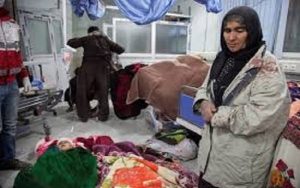
Kermanshah earthquake, an added dilemma for distressed people
Only one year after Kermanshah earthquake, and while the people in different cities of the province are still living in tents or trailers, another quake shook the area.
The 6.3 in magnitude earthquake shook vast parts of western Iran at 8 pm local time, on November 25.
Initial estimates indicate that more than 700 were injured and at least 7 people were killed.
Kermanshah earthquake, an added dilemma for distressed people
Although precise data regarding the situation of those affected by the earthquake is not at hand, a brief look at the circumstances after last year’s earthquake speaks for itself.
The inhabitants of the earthquake stricken areas have addressed their problems via the media times and again. The social activists setting up tweeter campaigns have disclosed the regime’s inaction throughout the last year.
While the regime abuses the official media as a mean to cover up its inefficiencies, rubbing salt into the people’s wounds, the deprived people even sell their kidneys to provide their lives and to rebuild their homes.
In this regard, the head of the city council of Sarpol-e Zahab, admitted: There are institutions that said they would support the earthquake stricken people to the end, but they left the work unfinished and handed the cases over to the Housing Foundation. Schools have been left unfinished. Many people have cleaned the rubbles on their own expense. He also revealed that some were willing to sell their kidneys for their construction work. No promise has been put into practice. Unemployment has become viral amongst the educated youths of Sarpol-e Zahab, one of the earthquake stricken cities. (Simaye Azadi, Sep,14,2018)
But the question is; how many more earthquakes should happen in order to secure the villages and cities in Iran against the quakes? How many more innocent people, including children, should be killed so that the national wealth would be used to rebuild and secure the earthquake-prone towns instead of fueling foreign conflicts? The main question is: When will this disarray, which is directly caused by the corruption in the urbanization system, end? Of course, this is only a small sample of the corruption that the regime is plunged in.
This corrupt regime, not only hasn’t done much to help the people in the earthquake stricken areas but also has stopped the nationwide flow of aid to these areas.
Ironically, the regime did the honorable people who rushed to aid our compatriots after the earthquake last year, including PMOI supporters from Kermanshah who rushed to help, answering the call of Mrs. Maryam Rajavi and the PMOI/MEK.
On November 25, after the recent earthquake, Mrs. Maryam Rajavi sent a message of condolences to the afflicted people and called on all the youths and fellow countrymen and countrywomen to help the earthquake stricken people.
I urge my countrymen and women, especially the brave youth, to rush to the aid of our afflicted compatriots struck by earthquake in #kermanshah and other cities and districts in western Iran, including Qasr-e Shirin, Sarpol-e Zahab, and Gilan-e Gharb.#Iran
Some residents selling their kidneys to gain money to rebuild their homes
Ten months have passed since an earthquake hit Kermanshah and dozens of aftershocks have kept the fear of a new catastrophe looming over the city and its population. But a new earthquake isn’t the most imminent danger that threatens to accelerate the deterioration of living conditions.
Fati, a 32-year-old housewife, says that they still don’t have a proper tent for living. With two four- and six-year-old kids she has to live with four other relatives in a tent that was originally created for four people.
The housing situation is so catastrophic that some of the residents are reportedly selling their kidneys in order to rebuild their homes.
In an interview with Iran’s Ilna news agency on September 14, Sarpol-e Zahab’s City Council Chairman accuses Hassan Rouhani’s administration of inaction and considers this the reason why some citizens are selling their kidneys.
He adds: “The mental situation of the citizens is very troubling. Hygiene and sanitation are very inadequate, and the municipality hasn’t yet given us any money to do something. I wish the Ministry of Interior would say what services they’ve provided for a city like Sarpol-e Zahab.”
On September 5, Irna news agency wrote about the housing situation: “Earthquake-stricken [families] with sick or elderly members or little children are more concerned, because if they don’t succeed in building their shelters, they have to spend a second cold winter in makeshift Conex houses and tents, not to mention the grueling summer heat they have to bear right now.”
And while the situation is far from normalized, state agencies are leaving the area one after another.
“On arrival, many of the agencies which came to the area, put up banners in the city saying that they will stand together with the earthquake victims until the end. Unfortunately, many agencies didn’t stay in the area and declared that they want to leave,” says Sarpol-e Zahab’s City Council Chairman.
On June 23, Iran’s Parliament news agency quoted an MP from Kermanshah saying: “Arrangements were made to give villages 350-million- and cities 400-million-rial loans but unfortunately, it was never realized.”
On August 18, Mehr news agency published a story-like report about the situation in Kermanshah nine months after the earthquake. Describing the situation of a family in Sarpol-e Zahab the report says: “She opens water on the soap that covers the 4-5-year-old boy’s face. The child’s body crumples under the sudden impact of the water’s cold temperature.”
The 40-year-old mother who lost her two brothers in the earthquake says: “I wash the kids in the toilet. We have one toilet for 40 people.” Referring to politicians and state affiliated celebrities who make empty promises and show off without helping them she continues: “Some people come here and take photos with our miseries.”
Iranians mourning next to the rubble of their home in Kouik village near to Sarpol-e Zahab, two days after a 7.3-magnitude earthquake
They say a news event has a three-day lifespan. The regime in Tehran is counting on such a theory to have the international community move on after the recent earthquake that shook western Iran. Each passing day further reveals the scope of this vast catastrophe.
“More than 1,000 people have lost their lives,” Iranian MP Ahmad Safari said to the official ILNA news agency 72 hours after the quake. “I went to a village where they said they pulled 20 corpses from under the rubble. They were not even counted in the death toll. 70 people died just in one alley of the town of Sarpol-e Zahab. Another 250 were killed in the Mehr housing complex.”
Experts advised the government of former Iranian president Mahmoud Ahmadinejad (2005-13) to build 25,000 homes under the Mehr blueprint. Ahmadinejad, however, ordered the construction of 1.5 million such units, raising questions of possible negligence in construction and lack of proper supervision.
While the ruling regime failed to provide any first aid relief, Iranian opposition leader Maryam Rajavi made an early call asking supporters to rush to their compatriots in need.
“Just as opposed to the practices of the clerical regime, now is the time to show solidarity. Assisting and saving the victims of the earthquake is a sacred national duty,” she said.
The incoming statistics of this recent quake are devastating. “There are still people stranded in villages where 90 percent of the homes are left destroyed. No official has visited these areas. The locals, along with their children, are forced to sleep the nights in their farm fields without any shelter,” a reported wired by the semi-official ISNA news agency reads.
Instead of focusing measures to rush aid for the victims, Iran’s regime imposedmartial law in Sarpol-e Zahab, the epicenter of the earthquake.
Was such a catastrophe preventable? Is Iran the only country prone to earthquakes?
Japan has a history of earthquakes and thanks to technological advances we no longer witness skyrocketing number of casualties and damages.
Australia also experienced a powerful 7.0-magnitude earthquake on Tuesday that resulted in tsunami warnings. No casualties or major damages were reported.
Preventing quake damage is nothing out of the ordinary or impossible. A truly popular government allocating the necessary manpower, means and budget can do the job. Here is exactly where the problem lies in Iran.
On August 13th members of the Iran’s parliament unanimously adopted a 16-article bill providing around $600 million to further develop Iran’s ballistic missile program and additionally fund the Revolutionary Guards (IRGC), especially the extraterritorial unit known as the Quds Force.
Iran’s five military entities enjoy a budget of $13.5 billion for the current Persian calendar year (March 2017 to March 2018), of which $7.4 billion belongs to the IRGC. This is a 24 percent increase from the last calendar year.
It is worth noting that the Iranian regime has a nearly $7 billion budget deficit, equaling to nearly half of its military budget.
Proper now would be to evaluate the money sent by the Iranian regime to Lebanon. There is actually no figure of Tehran’s financial support for the Lebanese Hezbollah.
While recent reports have placed this value at over $800 million, back in 2011 Al Arabiya Farsi shed further light in this regard.
“Hezbollah used to receive $350 million each year from Iran. In addition to Hezbollah’s own activities, this budget was used to provide for members’ salaries, the families of killed Hezbollah members, various projects in southern Lebanon and Beqaa, and bribing Lebanese political figures to back Hezbollah.”
One such $400 million construction project in Lebanon, including parks, was paid for completely by Iran. All the while millions in Iran remain under poor living conditions.
“As long as there is money in Iran, we will have money,” said Hezbollah Secretary General Hassan Nasrallah, making it crystal clear how the terrorist-designated group’s entire budget is bankrolled by Tehran.
Parallel to Lebanon, Iran is known for its belligerence in Syria, Iraq, Yemen and beyond.
Deprived of this budget, 40 percent of the Iranian people are living in complete poverty. 13 million homeless in city outskirt slums. 14 million literally cannot pay for their daily meals.
State-affiliated websites in Iran report nearly 20,000 homes were completely destroyed in the recent quake. Whereas in Japan, simple homes made with a budget of $10,000 each, have proven to be earthquake-resistant.
A picture taken on November 15, 2017 shows an Iranian woman gesturing next to the rubble of her home in Kouik village near to Sarpol-e Zahab, two days after a 7.3-magnitude earthquake struck Iran's western Kermanshah province near the border with Iraq, leaving hundreds killed and thousands homeless. Iranian authorities scramble to help tens of thousands of people left homeless by a major quake on the border with Iraq that killed more than 400 people as anger mounts among residents at what they see as a slow response
If we take into consideration just the abovementioned $600 million, Iran’s government could have provided 60,000 such homes for victims of the past three major quakes across the country.
This includes 20,000 in Kermanshah province, the site of the recent quake designated as the most powerful in 2017 so far; another 20,000 for the victims of the 2012 East Azerbaijan quake in northeast Iran; and 20,000 more for the victims of the 2003 Bam quake that left tens of thousands of innocent people killed.
This is all aside from sitting on an ocean of 125 billion barrels of oil, 227 trillion cubic meters of gas and a daily revenue of $200 million from exporting oil.
The point is the solutions are out there. Iran, however, is ruled by a regime that could care less about its populace. For those sitting in Tehran, this is a recipe for disaster.
Mohammad Biranvand, another member of Iran’s parliament said, “Do you know that the people now trust athletes and celebrities more than they trust government institutions? All this indicates that the earthquake of distrust will be far more destructive than the recent earthquake.”
Iranians living outdoors in bitterly cold temperatures after an earthquake are making desperate pleas for help.
BBC News, November 14, 2017 - More than 540 people were killed and at least 8,000 others have been injured when the quake hit near the Iran-Iraq border on Sunday. Night-time temperatures in Kermanshah province fell close to freezing for the second night in succession. Ali Gulani, 42, lives in the province's badly-hit town of Qasr-e-Shirin, said were burning crates to try to stay warm. 'We are living in a tent and we don't have enough food or water,' he said. 'You can hear children crying, it's too cold. They are holding on to their parents to warm themselves - it's pretty bad.' Mr Gulani said there were an average of three strong aftershocks an hour, provoking panic. Close to 200 aftershocks have hit the region since the magnitude-7.3 earthquake on Sunday night. It was one of the strongest on earth this year, as well as the deadliest.
Iranians explain what they've lost
Mr Gulani said he understood aid had been despatched within the province, but that people in his town had not yet received help. Instead, people were having to trek to the other side of town to get water from a tank. Iranian state TV said thousands of survivors had spent another night in makeshift camps or in the open. 'It is a very cold night... we need help. We need everything. The authorities should speed up their help,' one homeless young woman in Sarpol-e-Zahab, where most of the victims died, told Reuters news agency. One aid agency said 70,000 people needed shelter and the UN said it was 'ready to assist if required'. Iranian state news agency IRNA said 530 people had died in Iran alone. In the more sparsely populated areas across the border in Iraq, 10 people died and several hundred were injured. Mansoureh Bagheri, an Iran-based official with the Red Crescent Society, told the BBC about 12,000 residential buildings had 'totally collapsed'. She said now that rescue operations had ended, the priority was getting people into shelters as quickly as possible, and that the delivery of aid was on track. The Iranian Red Crescent said many areas lacked water and electricity and that aid supplies were being hampered by roads blocked by landslides. . Iranian army helicopters are taking part in the relief effort. About 30 Red Crescent teams are working in the earthquake zone, Irna reported. The earthquake struck at 21:18 local time (18:18 GMT) on Sunday, about 30km (19 miles) south of Darbandikhan in Iraq, near the north-eastern border with Iran. Tremors were felt as far away as Turkey, Israel and Kuwait.