‏نمایش پست‌ها با برچسب UN. نمایش همه پست‌ها

۱۳۹۷ آبان ۸, سه‌شنبه

UN Rapporteur: A new wave of executions, suppressions in Iran


The UN Special Rapporteur on the  human rights situation in Iran, Javid Rehman, presented his report in his first mission, in front a UN panel in New York on Wednesday, with the United Kingdom, United States and the European Union criticizing the increase in executions and suppressions inside the Islamic Republic.
 Rehman, a British-Pakistani legal scholar, reported that Iran has witnessed lately a wave of protests against the economic and living conditions which the authorities tried to suppress.
Rehman called on the Iranian government to allow him to visit the country in order to assess the human rights situation through interviews with Iranian citizens and to provide information on reports provided by international human rights organizations on violations, particularly executions, torture, suppression of freedom of assembly, opinion and expression, as well as depriving religious and ethnic minorities of their fundamental rights. 

Concern 

Following the UN meeting, Javed held a press conference at the UN building where he expressed concern about the fate of the environmental activists held for months in Iran.
The UN Special Rapporteur also considered the arrest of women against the compulsory hijab as a violation of human rights and international laws, while expressing concern about the fate of the detainees of protests in recent months in various cities in Iran.
Rahman stressed that the United Nations monitors the protests in Iran, especially the suppression and abuse of detainees, which led to the death of some people in prisons.
The UN Rapporteur pointed to a wave of suppression and threats against journalists, as well as the imprisonment of dual citizens and the execution of political prisoners, especially members of minorities.
He called on the Iranian government to interact with him to bring about positive changes in the human rights situation. He revealed that he held two meetings with representatives of Iran in Geneva and New York, wrote letters and held talks to decide on his request to visit the country.

۱۳۹۷ مهر ۷, شنبه

Iranian regime’s woes exposed at the UN General Assembly

Many view the meeting of the United Nations General Assembly held every year in the fall as an opportunity to make peace with the rest of the world with the exception of a handful of nations such as the Iranian regime. This year is no different for ruling clerics at odd with the world.
Aside from internal criticism over the financial burden of the trip especially when ordinary Iranians are desperate and worried about the rising cost of living, President Hassan Rouhani’s address would have no significance since the final word comes from Tehran and the regime’s Supreme Leader Ali Khamenei.
Every year, a big delegation is sent to the international event. Not counting those with an actual mandate such as the president or the foreign minister a large group of family members or even distant relatives of the regime’s officials tag along.
They simply get the free ride for sightseeing and shopping while their husbands or fathers showcase their supposed love and devotion for poor and impoverished not only in Iran but throughout the world. What a mockery of human values.
No doubt the Iranian regime has prepared a well rehearsed scenario for this year for the most important gathering of heads of states in New York. Ali Khoram a regime’s seasoned diplomat and close to Rouhani’s camp prescribed for the president to play it safe and refrain from the usual fiery speeches which are only good for internal consumption.
Khoram went on to tell Rouhani to play the martyr and complain about return of sanctions and how much it has bitten the ordinary citizens especially children and those in dire need of medicine.
The state-run daily Kayhan, which is a mouthpiece for Khamenei warned Rouhani and advised him to follow the strict guidelines set by the Supreme Leader.
Kayhan sarcastically wrote: “Those who are nostalgic for renegotiations with the United States are moles and spies.” “Overt or covert meetings with former ‘bodies’ from good old days of negotiations for nuclear deal do not go unnoticed,” the paper added.
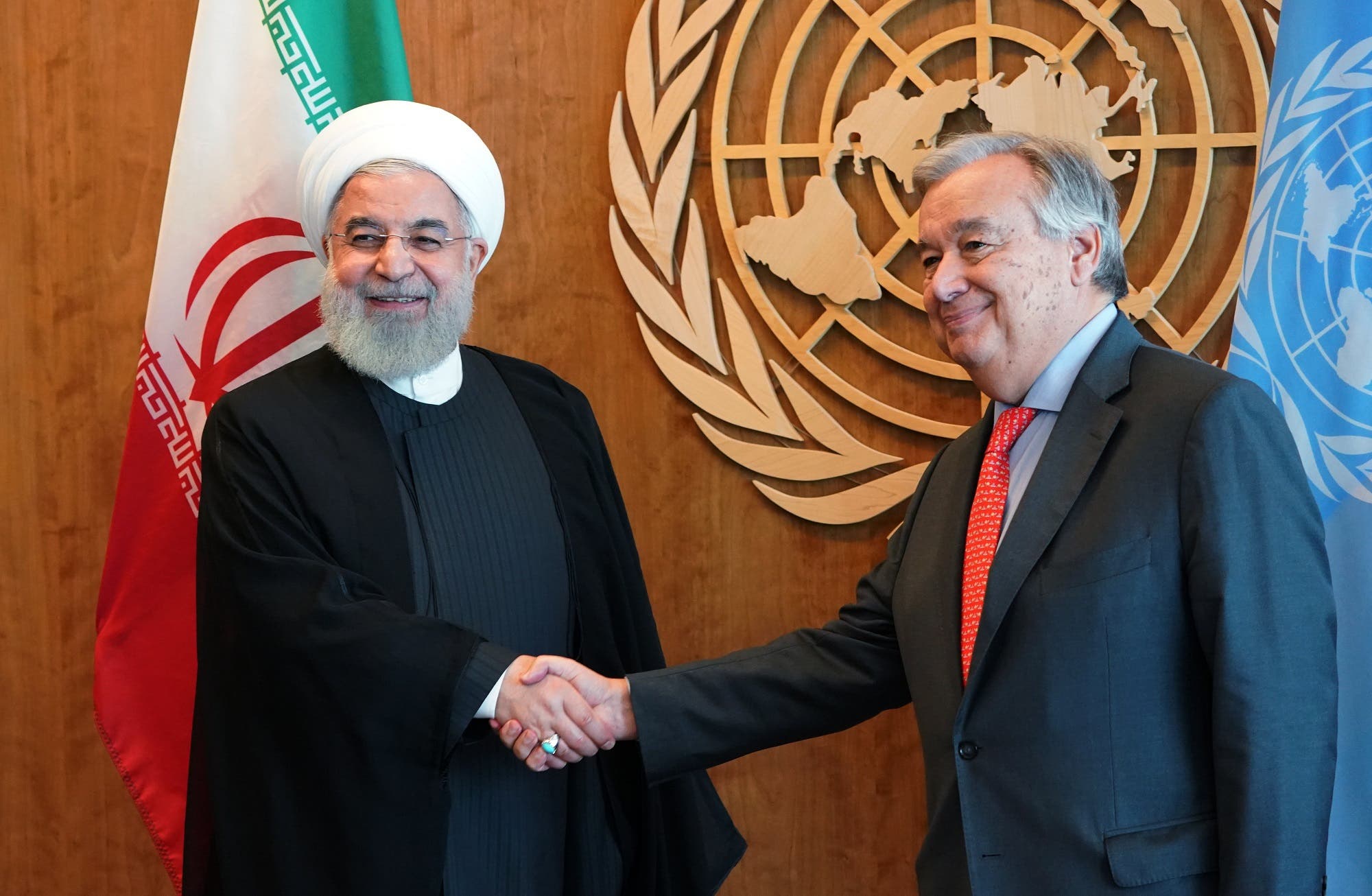
President Rouhani meets with UN Secretary General Antonio Guterres in New York on September 26, 2018, on the sidelines of the United Nations General Assembly. (AFP)

Iranian regime at an impasse

Despite the rivalry among two main factions of the regime and their plans and recommendations for saving the regime’s skin, Khamenei is in a serious dilemma that has crippled him. Iran’s national currency is plummeting everyday signaling a dying economy. Iran’s currency market according to traders is acting crazy and there is no hope.
“The US dollar price skyrocketed in Tehran’s markets on Monday, soaring over 160,000 rials. The euro was selling between 175,000 to 189,000 rials. The British pound had increased to over 210,000 rials.”
The state-run ISNA news agency described these escalating statistics as “strange” and added, “Today, trading for the US dollar began at around 149,000 to 150,000 rials and even reached the 155,000 rial mark.” These statistics were registered in authorized currency exchanges. In Tehran’s black market, however, the prices reached over 160,000 rials.
A citizen told Jahan-e-San’at daily on September 6th, “I earn around 22 million rials a month. With a mortgage of 9 million and two children, how can I buy 1 kilogram of rice for 100,000 rials, red meat at 600,000 rials and fruits at least 80,000 rials for each kilogram?”
Analyzing the increasing price of essential goods, the state-run ILNA news agency reported on September 11th: “In September, an average worker’s family must spend 72 percent of their earning to simply remain alive. At the end of the day, this family has less than 4 million rials to provide for their essential necessities, such as mortgage, transportation, and education. But how?”
Truckers went on strike again this week over high cost of maintenance and low incomes. The new round of strike hit hard on September 22th in Yazd, Mashhad, Shiraz, Karaj, Neka, Sanandaj, Bukan, Dezful, Bardsir, Borujerd, Isfahan, Shapur Jadid, Qazvin, Urmia, Bandar Abbas, Bandar Khomeini & the Khorram Abad/Pol-e Dokhtar.
Shiraz’s Prosecutor, Ali Salehi, threatened the truckers with legal action. He used the key word often used by the Iranian regime’s judiciary officials to threaten people with death. Salihi said: “Those continue the strike and break the law could be prosecuted as ‘Mohareb’ (waging war against God deemed a capital crime in Islam publishable by death).”
Not a day goes by without fresh strikes and protests in Iran. So far the theocratic regime has responded with an iron fist. In past three weeks 31 prisoners were hanged in different cities across the country. Nine were hanged together in the central city of Shiraz on September 22th.
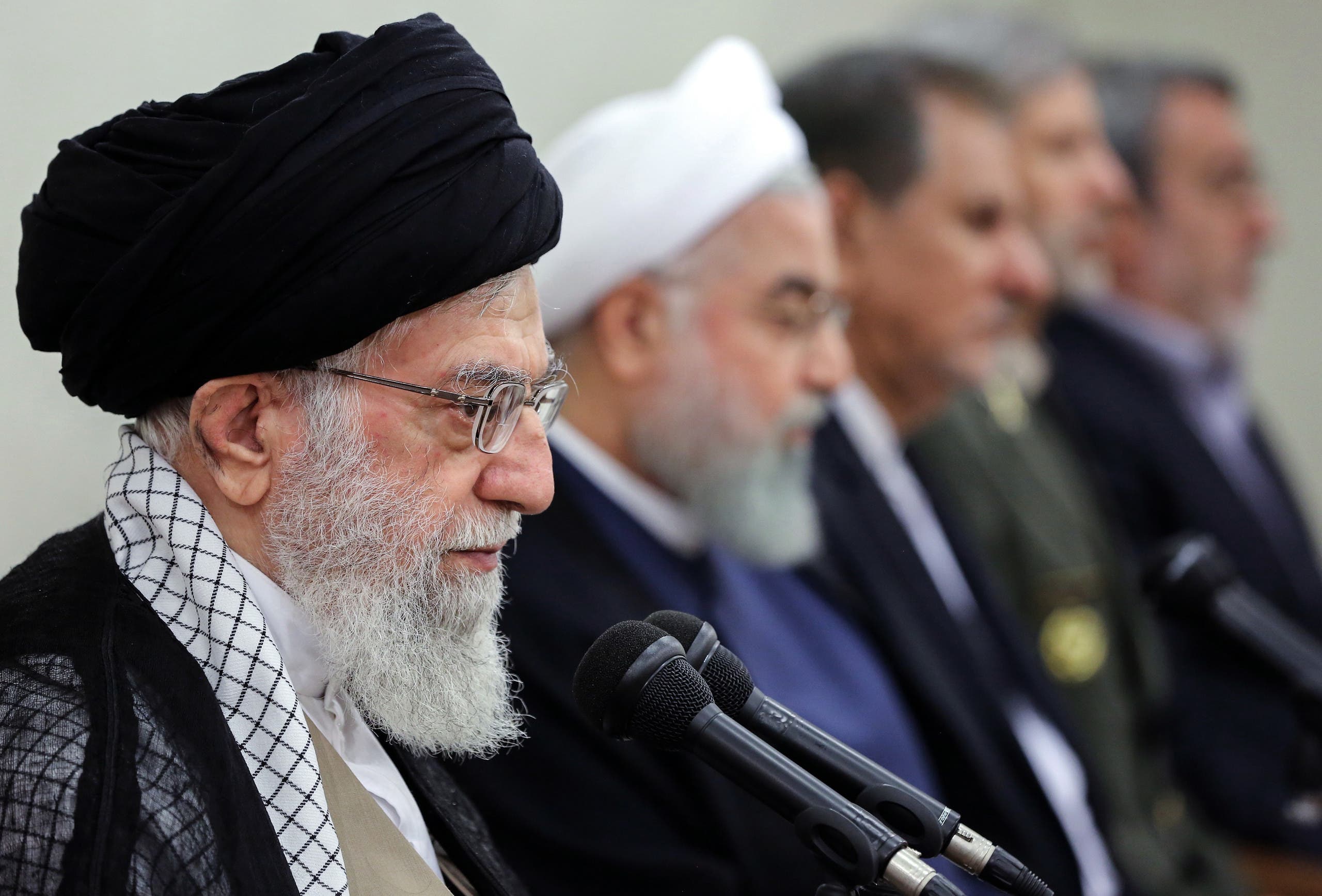
A handout picture shows Iran’s Supreme Leader Ayatollah Ali Khamenei speaking during a government meeting in Tehran on August 29, 2018. (AFP)

Nightmare for Khamenei

Khamenei no longer hide his biggest nightmare: fear of its main opposition growing in numbers and gaining strength in Iran.
According to the regime’s analysts, the People’s Mojahedin Organization of Iran (PMOI/MEK) has been behind every protest and strike especially in the past eight months. Khamenei’s fear is valid since many in the world have come to realize that this regime has lost all credibility and his biggest nightmare is coming true.
Last week was a show of force for those Iranians dreaming for a genuine democratic change in Iran. Iranian American Communities conference’s “2018 Iran Uprising Summit” was it. Many former American and European officials were present. The keynote speaker was Maryam Rajavi, President of the National Council of Resistance (NCRI). She addressed the meeting via video feed.
“We call on the United States to expel the Iranian regime’s operatives from America. We urge Western governments to shut down or restrict the regime's embassies, which are control centers for espionage and terrorism; and to expel this regime's criminal forces from Syria and Iraq.” The opposition leader added: “Iran’s seat at the United Nations does not belong to the terrorist regime ruling it. That seat belongs to the Iranian people and Resistance,” Rajavi said.
Time has come for a new era in Iran without the clerical regime. 
-------------------------------------------------------------------------- 
Reza Shafiee is a member of the Foreign Affairs Committee of the National Council of Resistance of Iran (NCRI). He tweets @shafiee_shafiee.
By Reza Shafiee

۱۳۹۷ مهر ۳, سه‌شنبه

The Protest Sponsored By Association Of Iranian Over Rouhani’s Speech At UN

The protest sponsored by Association of Iranian over Rouhani ‘s Speech at UN
The UN General Assembly is going to hold its annual session on 7 September 2018.
Hassan Rouhani, the Iranian regime’s president, is also attending.
The United Nations General Assembly which is one of the six bodies of the organization and represents all 193 members of it, holds annual meetings in late September. Attendance of many heads of state, premiers, and foreign ministers of countries makes the UNGA annual meetings an important venue for the world leaders to address the most important national, regional, and international issues in their speeches.
Organization of Iranian-American Communities-US (OIAC), the largest, most active grass root body of Iranian Diaspora in the United States, and other peace-seeking Iranians and Americans association, invites all concerned citizens to join the supporters to the “Free Iran Rally”, scheduled for Tuesday September 25, 2018, outside the United Nations Headquarters in New York City.
The gathering will bring thousands to the U.N. against the backdrop of increasing executions in Iran just as the U.N. General Assembly meetings convene. The Association of Iranian American is going to announce to the world that Rouhani does not represent the people of Iran. He is a murderer like Khomeini and Khamenei and other leaders of the Iranian regime. Rouhani directly involved in the repression and killing of Iranians.
The Association of Iranian American also calls on the United Nations to hold Iran’s rulers accountable for their crime against humanity.
Many human rights activists, prominent civic and political leaders will join to the thousands of Iranian-American community members to condemn unabated executions in Iran, and to denounce Iranian government’s malign role in the Middle East, particularly in Syria, Iraq, Yemen, and Lebanon. The gathering supports and echoes the rights of Iranian people and their organized resistances for democratic regime change in Iran.

۱۳۹۷ شهریور ۲۸, چهارشنبه

West has a chance to bring Iranian regime to heel at UN Security Council

West has a chance to bring Iranian regime to heel at UN Security Council

This Islamic Republic of Iran is mired in crises, few of which stem from US President Donald Trump’s withdrawal from the 2015 nuclear deal and the subsequent renewed economic sanctions. Those actions only serve to help the US, and hopefully the international community as a whole, in putting pressure on Iran’s clerical regime at a time when it is most vulnerable and least likely to conceal the misdeeds that make such pressure necessary.
 
Iran’s national currency, the rial, plumbed new depths this month, trading at more than 150,000 to the US dollar. The new figures provoked further economic protests in various Iranian cities, in what has become the status quo in recent months. The Iranian people view the economic catastrophe as part of the broader failings of the Iranian government, and many of the protests have accordingly taken on an unequivocal message of opposition to the regime in its entirety.
 
Activists have chanted “death to the dictator” and “death to Rouhani,” in reference to the country’s supreme leader and its president. Others have doubled down on the condemnation of both political factions of the clerical regime, while also rejecting the regime’s attempts to dismiss the unrest as the product of some foreign conspiracy. “The enemy is here,” protesters declared, according to independent Iranian news outlets and witnesses on social media. “They are lying when they say it is America.”
 
But the Iranian people are not simply declining to blame the West for their problems. The Mujahedin-e Khalq (MEK), a major driver of the protest movement, insists that the Iranian people are in fact calling out to the US and Europe to stand with them as they take hold of the solutions to their problems.
 
We can do this by focusing international attention on the human rights abuses with which the Iranian regime responds to any and all popular threats to its hold on power. We can also weaken the regime’s repressive infrastructure by building a broader consensus for economic sanctions and diplomatic isolation that will ultimately force the mullahs to respond to the crises they are presently trying to suppress.
 
A combination of internal and external pressure could finally bring the Iranian regime to heel, thereby ushering in both democracy at home and security abroad.
Dr. Majid Rafizadeh
The worsening economic and social conditions, along with the popular response to them, amplify the inherent potential of assertive Western policies. 
 
Clearly, the Trump administration’s decision to convene the UN Security Council to discuss Iran-related issues on Sept. 26 comes at an auspicious time, providing an opportunity to condemn the latest arrests and human rights violations involving peaceful protesters, and to underscore the ineffectiveness of those measures. The 2018 Iran Uprising Summit planned in advance of that meeting will echo this message.
 
In August alone, Iranian authorities arrested approximately 1,000 protesters. In January, in the midst of the nationwide uprising, arrests exceeded 8,000. Arrest in the Islamic Republic usually involves long periods of isolation, followed by torture, as security forces clamor for false confessions to support political charges. 
Recent examples are numerous and come as no surprise to Western observers, after several American and European nationals were caught up in the regime’s efforts to suppress all manner of perceived threats to its hard-line Islamist identity.
Visitors to the Islamic Republic are not the only Westerners at risk from the regime’s desperate bid to resolve its domestic crises through violence. The acknowledged role of the MEK in the uprising has prompted Tehran to target the popular democratic resistance group outside of Iran. Fortunately, all serious attacks have been thwarted so far, but had they managed to slip past European security services, terrible damage was plotted in March against the MEK community in Albania. On June 30, targets included hundreds of American and European dignitaries attending an international rally outside Paris organized by adherents of the National Council of Resistance of Iran (NCRI) and its president-elect, Maryam Rajavi.
The unraveling of the latter attack led to the arrest of Assadollah Assadi, a high-level diplomat at the Iranian embassy in Vienna, who masterminded the plot hatched at the highest levels in Tehran. His arrest exposed a terrorist operative hidden at the heart of Europe, and that Tehran’s anxiety at the domestic unrest and the MEK’s advances outweighs all other considerations, including relations with the EU.
A continuation of rights abuses in Iran means a perpetuation of terror threats abroad, while preventing Tehran from further abuses in one of these areas will ultimately make the regime’s entire project of self-preservation unsustainable.
The recent terror attempts should make it apparent to both sides of the Atlantic that Western interests and the Iranian people’s interests are one and the same. A combination of internal and external pressure could finally bring that regime to heel, thereby ushering in both democracy in Iran and security abroad. This is a message that should be emphasized at the Security Council this month.
  • Dr. Majid Rafizadeh is a Harvard-educated Iranian-American political scientist. He is a leading expert on Iran and US foreign policy, a businessman and president of the International American Council. Twitter: @Dr_Rafizadeh
Disclaimer: Views expressed by writers in this section are their own and do not necessarily reflect Arab News' point-of-view

۱۳۹۷ تیر ۲, شنبه

UN advisory orgs issue statement on Iran’s 1988 massacre

Human Rights Council - Joint Statement by 3 Human Rights Organization - 1988 Massacre

 As the 38th annual United Nations Human Rights Council session begins in Geneva, and on the verge of the 30th anniversary of the 1988 massacre of over 30,000 political prisoners in Iran based on the criminal order issued by Iranian regime founder Ruhollah Khomeini, three UN advisor organizations issued a statement officially recognizing this atrocity and calling for an international probe to place those responsible before justice.
France Liberte, the Movement Against Racism and For Friendship Amongst Nations (MRAP) and the International Women’s Human Rights Association issued their letter to UN High Commissioner for Human Rights Zeid Raad Al Hussein.
“The human rights situation in Iran continues to deteriorate. The Iranian regime responded to May’s peaceful demonstration of Kazerun in the south by opening fire, leaving at least four dead and many others injured.
“The crackdown in Kazerun followed the use of similar inhumane methods to target January’s peaceful demonstrations when regime authorities arrested thousands and dozens, including many under torture, were murdered in prison.
“One of the reasons behind the Iranian regime’s appalling elimination of dissidents is the immunity they have enjoyed despite their inhumane crimes, the most important of which being the massacre of 30,000 political prisoners in 1988.”
Most of the 1988 massacre victims are members and supporters of the Iranian opposition People's Mojahedin Organization of Iran (PMOI/MEK).

The text continues:
“The perpetrators of this crime enjoy immunity as we speak and many of them are in key positions in the judiciary or the government. The current Iranian Justice Minister is among them.”
The statement goes on to refer to human rights organizations reports on the Iranian regime’s measures aimed at destroying mass graves sites associated with the 1988 massacre victims in order to cover up this heinous crime.
“This tactic is destroying key evidence that can be used to discover the truth about the scope of the committed crimes, and seek justice and compensation for the victims and their families.
“These sites are under tight security surveillance and this shows judiciary, intelligence, and security entities were involved in the decision-making process of destroying these graves.
“Through the course of 2017 the Justice for the Victims of 1988 Massacre in Iran (JVMI) conducted a separate and extensive probe into this massacre by interviewing the victims’ relatives and eyewitnesses, and analyzing witness reports, images, confessions and remarks of current and former Iranian regime officials who had a role in this mass killing.
“This association has issued two separate reports in 2017 publishing details of 59 mass graves in Iran where it is believed 1988 massacre victims were secretly buried.”
France Liberte, MRAP, and the International Women’s Human Rights Association went on to emphasize in their joint statement: “Now is the time for the UN High Commissioner on Human Rights to launch an international investigation into the 1988 massacre and justice to be served for the victims of this crime against humanity.”

۱۳۹۶ بهمن ۲۷, جمعه

US wants UN action over report on Iranian missiles to Yemen


US Ambassador to the UN Nikki Haley -- shown here in December 2017 -- called on the UN Security Council to take action against Iran over its alleged activity in Yemen

US Ambassador Nikki Haley said Thursday that it was 'time for the Security Council to act' following the release of a report by UN experts concluding that Iran had violated the arms embargo on Yemen.
The report found that Tehran had failed to block supplies to Yemen's Huthi rebels of ballistic missiles that were fired at Saudi Arabia.
'This report highlights what we've been saying for months: Iran has been illegally transferring weapons in violation of multiple Security Council resolutions,' Haley said in a statement.
The ambassador added that 'the world cannot continue to allow these blatant violations to go unanswered' and that Tehran must face 'consequences.'
'It's time for the Security Council to act.'
Iran has strongly denied arming the Huthis and has accused Haley of presenting 'fabricated' evidence that a November 4 missile fired at Riyadh airport was Iranian-made.
Diplomats said the Iranian violations are likely to be addressed in a draft resolution renewing sanctions on Yemen that the council is set to adopt later this month.
It remains unclear however if Russia will back any move that punishes Iran.

۱۳۹۶ بهمن ۱۰, سه‌شنبه

Iran is violating UN weapons' embargo


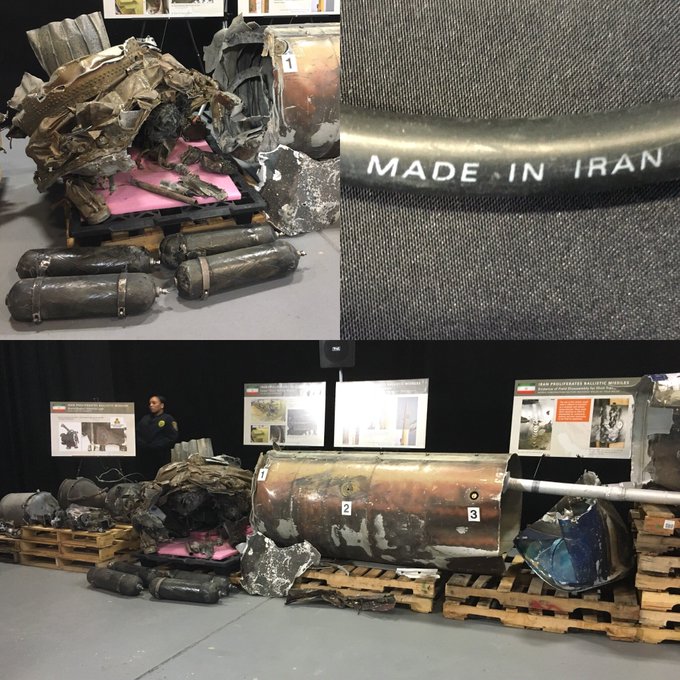
Items in this wearhouse are collected as evidence of Irans violation of UNSC resolution

US Mission to the UN is moveing the evidence of Iran's malign activities in the region, namely providing missiles to the Houthi rebels, to Washington. in a statement on the USUN twitter account it said: 'We brought the Security Council to DC to see first-hand evidence from the Department of Defense of Iran’s illegal weapons program. These violations cannot continue.'

۱۳۹۶ بهمن ۷, شنبه

Nikki Haley insisted on strong US Cyber defence


US Ambassador to the UN, Nikki Haley

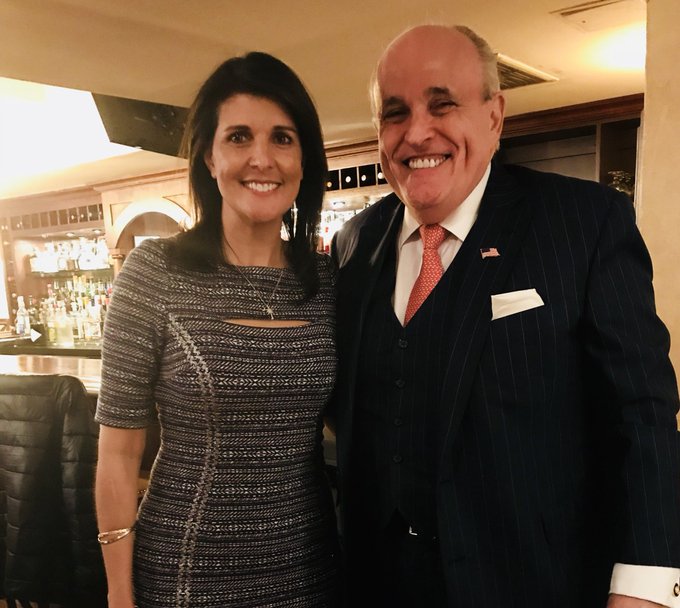
Following a meeting with the America's Mayor, Rudy Giuliani, US Ambassador to the UN said via her tweet that 'Great meeting with America’s Mayor on security and cyber threats around the world. The US has to stay strong on all things cyber.'


۱۳۹۶ آبان ۲۷, شنبه

Japan asks UN council to extend Syria gas attacks probe for 30 days


A toxic gas attack in the northwestern Syrian town of Khan Sheikhun on April 4 triggered global outrage as images of dying children were shown worldwide

 Japan on Thursday asked the UN Security Council to renew for 30 days a UN-led investigation of chemical weapons attacks in Syria, according to a draft resolution obtained by AFP.
The request came after Russia vetoed a US-drafted resolution that would have extended for a year the Joint Investigative Mechanism (JIM) and a second Russian-proposed measure failed to win enough votes at the Security Council.
Japan's proposed measure would allow more time to negotiate a possible compromise to allow the panel to continue its work of identifying those responsible for toxic gas attacks in Syria.
The draft measure would renew the JIM mandate for 30 days and task UN Secretary-General Antonio Guterres with submitting to the council in 20 days 'proposals for the structure and methodology' of the panel.
Japan requested a vote for Thursday, but diplomats said it was more likely that the council would consider the measure on Friday morning.
Russia earlier cast its 10th veto on Syria at the top UN body, blocking the one-year extension of the JIM as proposed in a US-drafted resolution that won 11 votes.
A Russian-drafted resolution fell short of the nine votes required for adoption, garnering just four votes in favour.
Russia has sharply criticized the JIM after its latest report blamed the Syrian air force for a sarin gas attack on the opposition-held village of Khan Sheikhun that left scores dead.
The attack on April 4 triggered global outrage as images of dying children were shown worldwide, prompting the United States to launch missile strikes on a Syrian air base a few days later.
Syria has denied using chemical weapons, with strong backing from Russia.
The joint UN-Organisation for the Prohibition of Chemical Weapons (OPCW) panel was set up by Russia and the United States in 2015 and unanimously endorsed by the council, which renewed its mandate last year.

۱۳۹۶ شهریور ۱۳, دوشنبه

New Light On Iran's Human Rights Violations


UN Secretary-General Antonio Guterres addressing UN delegates at the General Assembly December 12, 2016 at the United Nations in New York.

Forbes, September 4, 2017 - Two of the major crises the international community is currently engaged with are terrorism and nuclear proliferation. Iran, in particular, is negatively involved in both fields, being known as the central banker of international terrorism, and suspicious for its own controversial nuclear program at home parallel to its nuclear/missile collaboration with North Korea.
As these subjects are of significant importance and deserve even more attributed attention, what must not go neglected is the fact that Iran is taking advantage of such circumstances to continue an equally important campaign of belligerence against its own people. The scope of human rights violations carried out by Tehran is continuously on the rise, with the ruling regime interpreting the mentioned international crises as windows of opportunity to extend its domestic crackdown.
And yet, a promising report issued from the United Nations has shed very necessary light on a specific dossier Iran has gone the limits throughout the past three decades to cloak. In 1988 the Iranian regime carried out an atrocious massacre sending tens of thousands of political prisoners to the gallows. Unfortunately, the world has until recently remained silent in this regard.
Twenty nine years after the atrocious carnage, Asma Jahangir, the UN Special Rapporteur on the situation of human rights in Iran, issued a report on September 2nd for the first time referring to the massacre of over 30,000 political prisoners, mostly members and supporters of the Iranian opposition People's Mojahedin Organization of Iran (PMOI/MEK).
This document, coupled with a note by UN Secretary-General Antonio Guterres and presented to the UN General Assembly, has for the first time specifically attributed a number of articles to the 1988 massacre. Thousands of men, women, and juveniles were sent to the gallows and buried in mass, unmarked graves, all according to a fatwa, or decree, issued by the deceased Iranian regime founder Ayatollah Khomeini.
Raising the stakes to a level Tehran has sought to avoid through the years, this damning UN report has called for an independent and thorough inquiry into these crimes to unearth the truth of the atrocities carried out in the summer of 1988.
Activists and the Iranian Diaspora have for 29 years focused their measures on presenting evidence of the killings. This has finally been acknowledged in this UN report.
“Between July and August 1988, thousands of political prisoners, men, women, and teenagers, were reportedly executed pursuant to a fatwa issued by the then Supreme Leader, Ayatollah Khomeini. A three-man commission was reportedly created with a view to determining who should be executed. The bodies of the victims were reportedly buried in unmarked graves and their families never informed of their whereabouts. These events, known as the 1988 massacres, have never been officially acknowledged. In January 1989, the Special Representative of the Commission on Human Rights on the situation of human rights in the Islamic Republic of Iran, Reynaldo Galindo Pohl, expressed concern over the “global denial” of the executions and called on Iranian authorities to conduct an investigation. Such an investigation has yet to be undertaken.”
The atrocities, of such grave nature, rendered a major rift amongst the regime’s leadership and highest authorities. The late Ayatollah Hossein-Ali Montazeri, then Khomeini’s designated successor, expressed his opposition to the killings and the massacre came back to haunt a presidential hopeful in the most recent such election held back in May.
“In August 2016, an audio recording of a meeting held in 1988 between high-level State officials and clerics was published. The recording revealed the names of the officials who had carried out and defended the executions, including the current Minister of Justice, a current high court judge, and the head of one of the largest religious foundations in the country and candidate in the May presidential elections. Following the publication of the audio recording, some clerical authorities and the chief of the judiciary admitted that the executions had taken place and, in some instances, defended them.” 
The mentioned “head of one of the largest religious foundations” is none other than conservative cleric Ebrahim Raisi, said to be groomed by Iranian Supreme Leader Ali Khamenei to replace the incumbent Hassan Rouhani as president. Khamenei, battling with cancer, sought this as a launching pad in Raisi’s rise to succeed him as the regime’s leadership.
However, a nationwide campaign led by the network of PMOI/MEK-associated activists inside Iran exposed Raisi’s past and raised immense emotions and opposition amongst the Iranian population. This development left Khamenei no choice but to place his blueprints aside and allow another term for Rouhani as his regime’s president.
The UN report also refers to Raisi’s candidacy in May’s election.
Ebrahim Raisi
Mullah Ebrahim Raisi
“During the period of candidate registration, a total of 1,636 individuals, including 137 women, submitted their names as candidates for president. However, in April, the Guardian Council, a body of six clerics appointed by the Supreme Leader that oversees the electoral process and vets the candidates, announced that the candidatures of only six men (0.37 per cent of the applicants) had been approved. Among them was Ebrahim Raisi, who reportedly had served on a committee that had ordered the extrajudicial executions of thousands of political prisoners in 1988.”
The 1988 massacre victims’ families have throughout these years desperately sought to find the final resting places of their loved ones. All have been provided next to no information by the regime’s authorities and left to search and grieve amongst the dozens of mass graves sites checkered across the country.
“In March, families who visited a mass grave located in the city of Mashhad, Razavi Khorasan Province, where up to 170 political prisoners are believed to be buried, reportedly discovered that the previously flat area had been covered with soil to create a raised mound over the grave. In mid-May, bulldozers were reportedly seen working on a construction project directly alongside the mass grave site at Ahvaz, located on a barren piece of land 3 km east of Behesht Abad Cemetery, where the remains of at least 44 people killed during the summer of 1988 are believed to be located. The plan is reportedly to ultimately raze the concrete block marking the grave site and build a “green space” or commercial development over the site.”
Khavaran cemetery, Iran
After decades of endless efforts by Tehran to keep a lid on the 1988 massacre, this UN reports demands dignity for the victims and their families.
“Over the years, a high number of reports have been issued about the [1988] massacres. If the number of persons who disappeared and were executed can be disputed, overwhelming evidence shows that thousands of persons were summarily killed. Recently, these killings have been acknowledged by some at the highest levels of the State. The families of the victims have a right to know the truth about these events and the fate of their loved ones without risking reprisal. They have the right to a remedy, which includes the right to an effective investigation of the facts and public disclosure of the truth; and the right to reparation. The Special Rapporteur, therefore, calls on the Government to ensure that a thorough and independent investigation into these events is carried out.”
The Iranian regime has considered the international community turning its back on this crime against humanity as a green light to continue its rampage of domestic crackdown and human rights violations.
The so-called “moderate” Rouhani has a dismal report card of over 3,000 executions during his first tenure, over 100 executions in July and at least 55 such cases in the month of August, according to reports.
The regime also has no tolerance for even the slightest protest by political prisoners in its own jails. Nearly two dozen such inmates in Raja’i Shahr (Gohardasht) prison of Karaj, a town west of Tehran, are continuing their hunger strike for well over a month. They are protesting their illegal transfer to a section of the facility placed under 24/7 audio and visual surveillance, even in bathrooms and showers.
As Iran’s other bellicosities have rightfully raised international concerns in recent years, it is vital to understand that human rights violations are this regime’s chink in the armor.   No matter what their position, all ranks and files of the Iranian regime involved in the 1988 massacre must be held accountable in an international tribunal and face justice.